

Fat loss8 min read · Updated
Calorie Calculator: TDEE, BMR and Your Daily Target
- Trial 10% off
- No membership
- WhatsApp reply, usually within the hour
The short answer
Your BMR is the energy you burn at rest, estimated with the Mifflin-St Jeor equation.
- Multiply it by your activity factor, from 1.2 for a desk job to 1.9 for hard daily training, to get your TDEE.
- Eat about your TDEE to stay at your weight, 500 kcal less to lose about 0.5 kg a week, or 300 to 500 kcal more to gain.
- A lightly active 35-year-old woman of 160 cm and 62 kg burns about 1,766 kcal a day, so her loss target is 1,266 kcal.
Written by the Fit Titans coaching team. Edited by Theon. How we write guides
On this page (8)
- 1. How many calories do I need a day?
- 2. What is the difference between TDEE and BMR?
- 3. How do you work out your calories by hand?
- 4. Which activity level should you pick?
- 5. How big a calorie deficit is safe for weight loss?
- 6. What does your calorie target look like in hawker food?
- 7. Why is the number only an estimate?
- 8. Where does a personal trainer fit in?
Key facts
- Mifflin-St Jeor BMR: 10 x weight in kg + 6.25 x height in cm - 5 x age, then + 5 for men or - 161 for women (Am J Clin Nutr, 1990)
- TDEE is BMR times an activity factor: 1.2, 1.375, 1.55, 1.725 or 1.9
- Singapore's HPB-MOH obesity guidelines recommend a deficit of at least 500 kcal a day and loss of no more than 0.5 to 1 kg a week
- HPB's SG FoodID lists a plate of steamed chicken rice at 475 kcal and char kway teow at 974 kcal
How many calories do I need a day?
It depends on your size, age, sex and how much you move. Your BMR, the energy your body burns at rest, comes from the Mifflin-St Jeor equation. Multiplied by an activity factor it gives your TDEE, the calories you burn in a whole day.
Eat about your TDEE to stay at your weight, 500 kcal a day less to lose about 0.5 kg a week, or 300 to 500 kcal more to gain. A 35-year-old woman of 160 cm and 62 kg who is lightly active burns about 1,766 kcal a day.
Calorie calculator
- BMR, at rest
- 1,284 kcal
- TDEE, x 1.375
- 1,766 kcal
Lose about 0.5 kg a week, a day
1,266 kcal
That is 500 kcal a day under your TDEE, about 0.5 kg a week at first. Expect the rate to slow as you get lighter.
Hawker dishes as a share of 1,266 kcal
- Mee soto411 kcal 32%
- Sliced fish beehoon soup, no milk454 kcal 36%
- Steamed chicken rice475 kcal 38%
- Wanton noodles, dry625 kcal 49%
- Nasi lemak, chicken wing set815 kcal 64%
- Char kway teow974 kcal 77%
BMR from the Mifflin-St Jeor equation (1990) and TDEE from the standard activity multipliers. Dish figures are one default portion from HPB's SG FoodID database, checked 7 November 2026.
The BMR uses the equations in Mifflin and St Jeor's 1990 paper and the TDEE the five activity multipliers that a 2022 BMC Nutrition study applies to them. The dishes are one default portion each from HPB's Singapore Food Insights Database.
All checked 7 November 2026. It is an estimate for healthy adults, not medical advice, so if you are pregnant, under 18 or managing a medical condition, ask your doctor or a dietitian for your number.
What is the difference between TDEE and BMR?
BMR is what you burn lying still for a day, and TDEE is what you burn living it. Mifflin and St Jeor measured the resting energy use of 498 healthy adults aged 19 to 78, about half of them obese, and fitted this equation to it: 10 x weight in kg + 6.25 x height in cm - 5 x age in years, then + 5 for men or - 161 for women.
TDEE adds everything else, from walking to the MRT to a training session, by multiplying the BMR by a factor for how active you are.
So BMR changes only as your weight and age change, while TDEE moves with your week. Your calorie target comes from TDEE, never from BMR alone.
How do you work out your calories by hand?
Work out your BMR, multiply it by your activity factor, then add or take away for your goal. Here it is for a 35-year-old woman, 160 cm tall and 62 kg, who does light exercise 1 to 3 days a week.
| Step | Sum | Result |
|---|---|---|
| Weight | 10 x 62 kg | 620 |
| Height | 6.25 x 160 cm | 1,000 |
| Age | 5 x 35 years, taken away | -175 |
| Women's constant | Taken away (men add 5) | -161 |
| BMR | 620 + 1,000 - 175 - 161 | 1,284 kcal |
| TDEE | 1,284 x 1.375, rounded | 1,766 kcal |
| To lose about 0.5 kg a week | 1,766 - 500 | 1,266 kcal |
| To stay at her weight | Her TDEE | 1,766 kcal |
| To gain | 1,766 + 300 to 500 | 2,066 to 2,266 kcal |
A man of the same age, height and weight would have a BMR 166 kcal higher, the gap between + 5 and - 161, and a TDEE about 228 kcal higher at the same activity.
Which activity level should you pick?
The one that matches an ordinary week, not your best one. Most people with a desk job who train two or three times a week are lightly active. If you sit between two levels, start with the lower one, then weigh yourself for two to three weeks and adjust. The table shows how much the choice moves the worked example.
| Activity level | What it looks like | Multiplier | Her TDEE |
|---|---|---|---|
| Sedentary | Desk job, little or no exercise | 1.2 | 1,541 kcal |
| Lightly active | Light exercise or sport 1 to 3 days a week | 1.375 | 1,766 kcal |
| Moderately active | Moderate exercise or sport 3 to 5 days a week | 1.55 | 1,990 kcal |
| Very active | Hard exercise or sport 6 to 7 days a week | 1.725 | 2,215 kcal |
| Extra active | Hard training every day, or a physical job as well as exercise | 1.9 | 2,440 kcal |
The gap from the bottom row to the top is 899 kcal a day. Picking a level too high is an easy way to overestimate what you can eat.
How big a calorie deficit is safe for weight loss?
About 500 kcal a day for most adults. Singapore's HPB-MOH clinical practice guidelines on obesity recommend diets with a deficit of at least 500 kcal below estimated daily needs, and say loss should preferably not exceed 0.5 to 1 kg a week.
HealthHub gives the same 0.5 to 1 kg ceiling. Writing for SingHealth's HealthXchange, Dr Tham Kwang Wei of Singapore General Hospital puts a 500 kcal daily cut at about 0.5 kg a week.
Bigger is not better. The same SGH article says eating under 1,000 to 1,200 kcal a day may be counterproductive, so this calculator never shows a loss target under 1,200 kcal. If 500 kcal under your TDEE would go below that, it stops at 1,200 and tells you the loss will be slower.
Diets of about 800 kcal a day or less are what the US National Institute of Diabetes and Digestive and Kidney Diseases calls very low-calorie diets, run under a health professional's supervision. If the scale is not moving on your number, the usual causes are in why am I not losing weight.
What does your calorie target look like in hawker food?
For the worked example's 1,266 kcal, a plate of steamed chicken rice is 38% of the day and a plate of char kway teow 77%. The figures are each dish's default portion in HPB's SG FoodID database, which replaced its older food composition database. Portions at your stall will differ, so treat them as a guide.
| Dish | Portion | Calories | Share of 1,266 kcal |
|---|---|---|---|
| Mee soto | 1 bowl, 622 g | 411 kcal | 32% |
| Sliced fish beehoon soup, no milk | 1 bowl, 811 g | 454 kcal | 36% |
| Steamed chicken rice | 1 plate, 346 g | 475 kcal | 38% |
| Wanton noodles, dry | 1 bowl, 388 g | 625 kcal | 49% |
| Nasi lemak, chicken wing set | 1 plate, 410 g | 815 kcal | 64% |
| Char kway teow | 1 plate, 480 g | 974 kcal | 77% |
Chicken rice for lunch and sliced fish beehoon soup for dinner come to 929 kcal, which leaves 337 kcal for breakfast, drinks and snacks. Swap the soup for char kway teow and the two meals alone are 1,449 kcal, over the day's target. Ordering tips stall by stall are in the hawker eating guide for fat loss.
Why is the number only an estimate?
Because the equation predicts the average person of your size, not you. In the 1990 study, weight, height, age and sex explained 71% of the differences in measured resting energy use between people, so two people with the same inputs can burn noticeably different amounts. The activity multipliers are a convention on top of that, and you cannot know which level fits until you see what your weight does.
Your needs also fall as you lose weight. The HPB-MOH guidelines note that every 24 kcal a day you cut eventually means about 1 kg less body weight, so a steady 500 kcal cut levels off about 21 kg lighter rather than carrying on at 0.5 kg a week.
Use the number as a starting point: hold it for two to three weeks, weigh yourself on the same mornings, and recalculate after every few kilos.
Where does a personal trainer fit in?
The calories decide how much weight you lose, and the training decides how much of it is fat rather than muscle. Fit Titans matches you with a freelance coach who trains you at home, in your condo gym, at a park or at a Gym Pod. Our coaches build the strength sessions and keep you consistent.
They are not dietitians, so a medical diet belongs with a dietitian. How coached fat loss works is on our weight loss page, training without a gym is in how to lose weight without a gym, and the protein side is in how much protein you need.
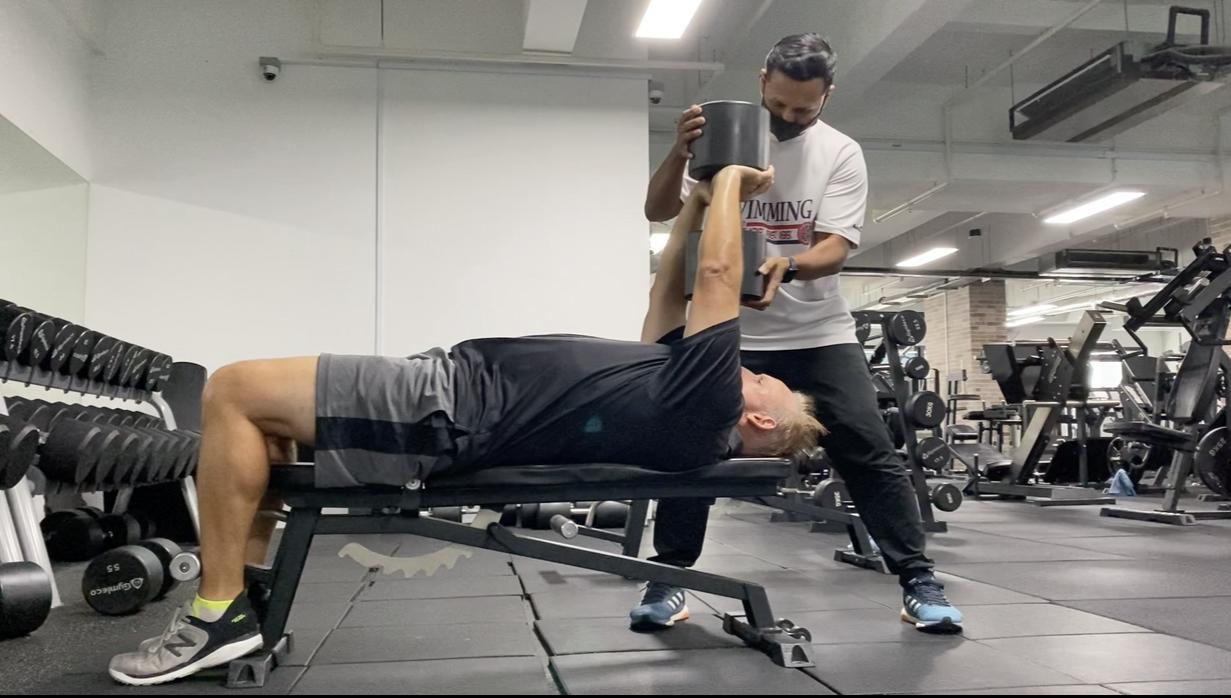
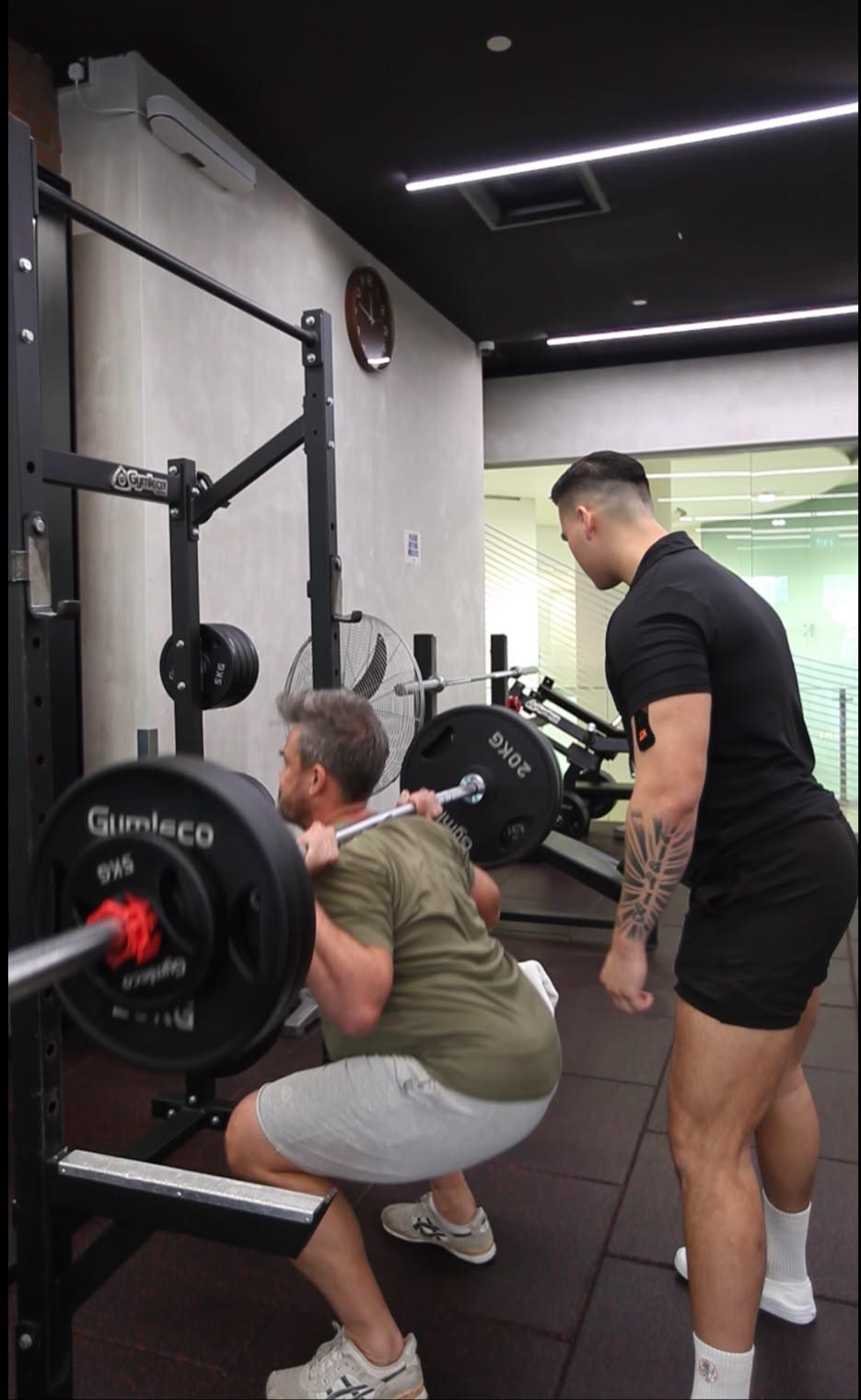
Our coaches at work
Real sessions from our coaches' own galleries. Swipe for more.





Calorie calculator questions.
How many calories should I eat to lose weight in Singapore?
About 500 kcal a day under your TDEE, which Singapore's HPB-MOH guidelines set as the minimum deficit for weight loss and which comes to about 0.5 kg a week at first. For a lightly active 35-year-old woman of 160 cm and 62 kg that is 1,266 kcal a day. Enter your own details in the calculator for yours.
Is 1,200 calories a day too little?
It is the lowest target this calculator will show. A Singapore General Hospital specialist writing for HealthXchange says eating under 1,000 to 1,200 kcal a day may be counterproductive, and diets of about 800 kcal or less are run under medical supervision. If your TDEE is already near that, moving more is a safer way to a deficit than eating less.
Is TDEE the same as maintenance calories?
Yes. TDEE is the calories you burn in a day, so eating that much keeps your weight about the same. A loss target sits below it and a gain target above it.
How many calories are in a plate of chicken rice?
HPB's SG FoodID database lists 475 kcal for a 346 g plate of steamed chicken rice and 643 kcal for a 363 g plate of roasted chicken rice. On a 1,266 kcal loss target, the steamed plate is 38% of the day.
How many extra calories do I need to gain weight?
The NHS suggests adults add around 300 to 500 kcal a day and gain weight gradually. Pair it with strength training so more of the gain is muscle. If you have lost weight without trying, see a doctor before eating more.
Why have I stopped losing weight on the same calories?
Because a lighter body burns less. Singapore's HPB-MOH guidelines note that every 24 kcal a day you cut eventually means about 1 kg less body weight, so a fixed deficit stops working as you approach that new weight. Recalculate with your current weight, and check that your portions and drinks have not crept up.
How accurate is the Mifflin-St Jeor equation?
Reasonably, but it is still an estimate. In its 1990 study of 498 adults, it explained 71% of the variation in measured resting energy use, and the older Harris-Benedict equations overestimated by 5%. Your real needs show up in two to three weeks of weighing against a steady intake.

About this guide
Published
Terms used
- HPB:
- Health Promotion Board, the government agency behind Singapore's public health guidance, including physical activity recommendations and the national effort on diabetes.
Sources
- Mifflin MD, St Jeor ST et al. A new predictive equation for resting energy expenditure in healthy individuals. Am J Clin Nutr 1990;51:241-7 (checked 7 Nov 2026) · PubMed
- Busgang SA, Malin AJ, Gennings C. My nutrition index: a method for measuring optimal daily nutrient intake. BMC Nutrition 2022, activity multipliers (checked 7 Nov 2026) · PubMed Central
- Health Promotion Board-Ministry of Health Clinical Practice Guidelines: Obesity, Singapore Medical Journal 2016 (checked 7 Nov 2026) · Health Promotion Board and Ministry of Health, via PubMed Central
- How to manage weight the healthy way (checked 7 Nov 2026) · HealthHub / Health Promotion Board
- How much weight to lose and how to lose it (checked 7 Nov 2026) · HealthXchange / Singapore General Hospital
- Very low-calorie diet, definition (checked 7 Nov 2026) · National Institute of Diabetes and Digestive and Kidney Diseases
- Healthy ways to gain weight (checked 7 Nov 2026) · NHS
- Singapore Food Insights Database (SG FoodID): mee soto, sliced fish beehoon soup, steamed and roasted chicken rice, wanton noodles, nasi lemak, char kway teow (checked 7 Nov 2026) · Health Promotion Board
General information, not medical advice.