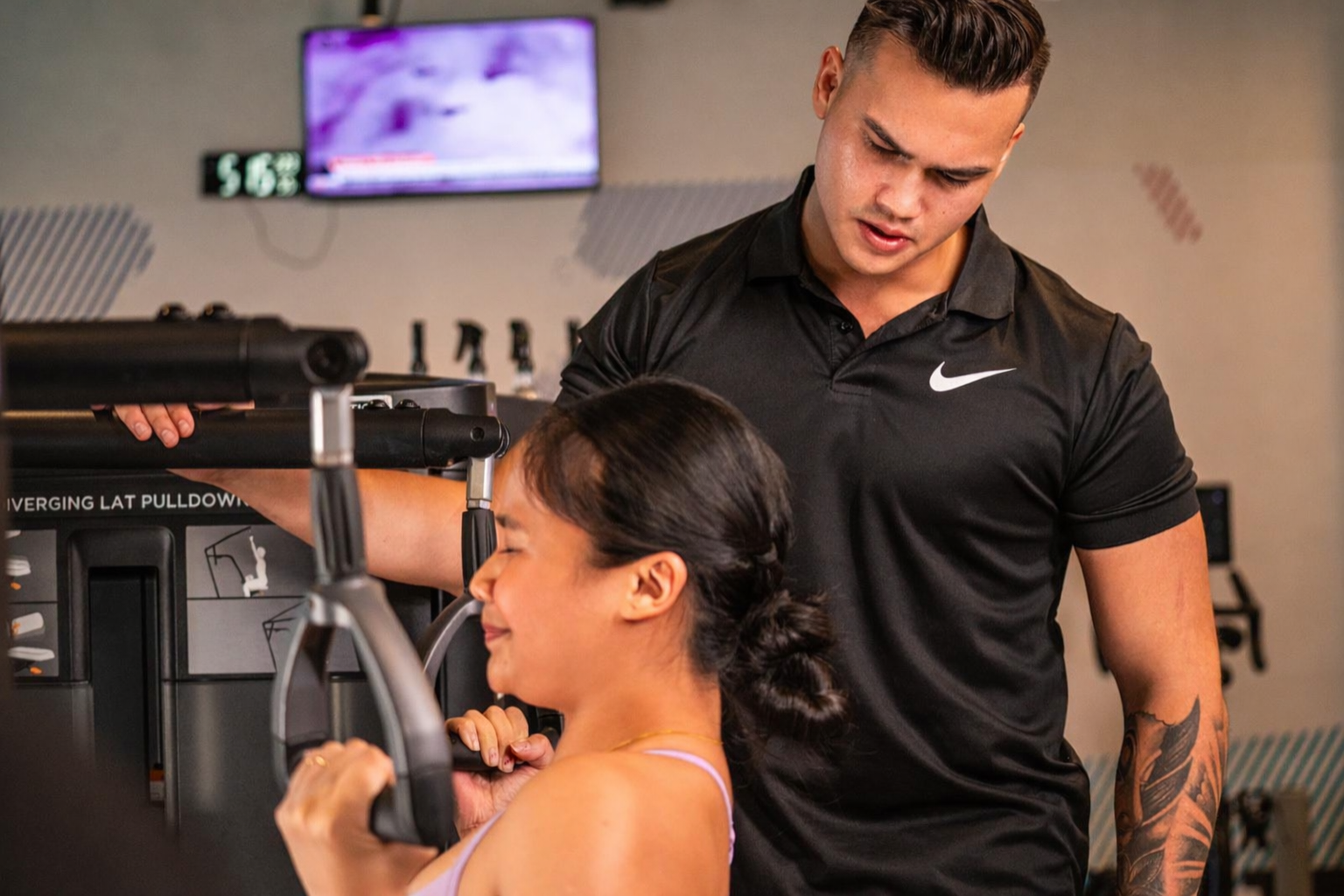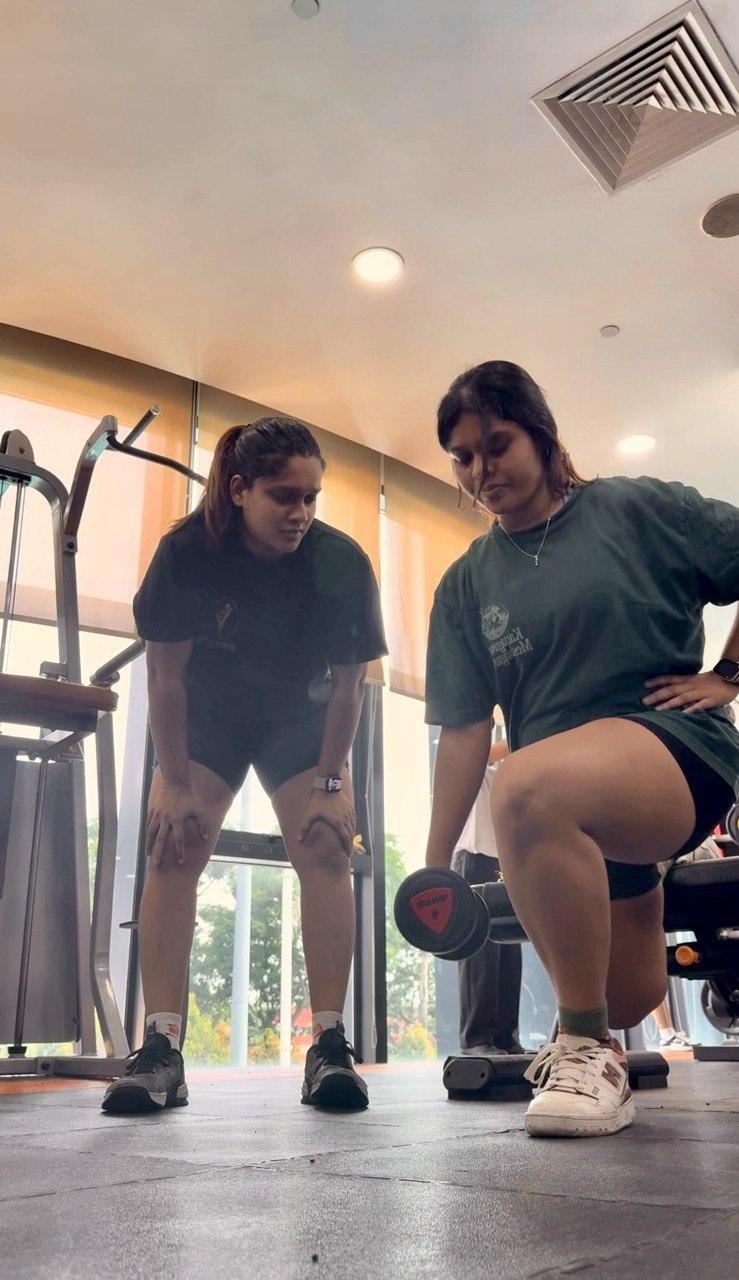
 Photo: Dimanya with a client
When can you start training after giving birth?
It depends on how you gave birth, and your own doctor's answer beats every row below. The American College of Obstetricians and Gynecologists (ACOG) says that after a healthy pregnancy and a normal vaginal delivery it is usually safe to begin exercising a few days after birth, or as soon as you feel ready, and that after a caesarean or complications you should ask your ob-gyn. In Singapore, KK Women's and Children's Hospital (KKH) tells caesarean mothers not to lift heavy objects for at least two months and to avoid strenuous activity that causes pain, and describes the postnatal review as possibly around six weeks after delivery.
| Vaginal birth, no complications | Caesarean birth | |
|---|---|---|
| Walking and pelvic floor exercises | Within days, when you feel ready (ACOG) | Pelvic floor exercises early; walking as comfortable; ask your doctor |
| Coached strength sessions | Light bodyweight work in the first weeks; a coached block usually after the postnatal review, around six weeks | After your doctor clears you; no heavy lifting for at least two months (KKH) |
| Swimming | Weeks 8 to 12, once bleeding has stopped (Goom et al.) | Weeks 8 to 12, once bleeding has stopped and the wound has healed (Goom et al.) |
| Running and jumping | Not before 3 months, and only without symptoms (Goom et al.) | Not before 3 months; often later (Goom et al.) |
Why a caesarean takes longer: the 2019 return-to-running guideline by Goom, Donnelly and Brockwell, written for doctors, physios and fitness professionals, cites research showing the abdominal fascia has regained only 51% to 59% of its original tensile strength six weeks after a caesarean, and 73% to 93% at six to seven months. A healed scar on the outside is not the same as a wall that can take load. Singapore's physical activity guidelines for pregnant and postpartum women say the same thing in plainer terms: ease back into activity gradually and consult your doctor when needed.
Why does the pelvic floor come first?
Because it carries the load of everything else you will do, and pregnancy and birth stretch it. A 2020 Cochrane review of 46 trials and 10,832 women puts urinary incontinence after childbirth at about one woman in three, and faecal incontinence at up to one in ten. It is common. It is also not something to train through or accept.
Every source agrees on starting early. ACOG's Committee Opinion 804 says pelvic floor exercises can begin in the immediate postpartum period; Singapore's guidelines say start them early; the UK Chief Medical Officers' postpartum guidance says begin as soon as possible and continue daily. KKH's discharge advice is to contract the muscles you would use to stop urinating, hold for three seconds and relax for three, build up to 10-second holds, and do 15 minutes a session, three times a day.
Be honest about what exercises alone can do. The same Cochrane review found that for postnatal women who already have leaking, the evidence that general pelvic floor training fixes it is uncertain, and that a blanket programme handed to every new mother is unlikely to reduce incontinence. What helps more is an individual assessment. The Goom guideline recommends every postnatal mother be offered a pelvic health assessment with a specialist physiotherapist from six weeks, whatever the type of birth. In Singapore, KKH's physiotherapy service runs pelvic floor rehabilitation, incontinence management and a postnatal care programme, and private women's health physiotherapists offer the same. A trainer cannot examine your pelvic floor. A good one will say so and send you to someone who can.
How do you check for diastasis recti, and when should you see a physio?
Diastasis recti is a gap between the two sides of the six-pack muscle, along the line down the middle of your belly. Some separation is normal. A Norwegian study that followed 300 first-time mothers found it in 60% at six weeks after birth, 45% at six months and 33% at a year, defining it as a gap of at least two finger-widths. Women with and without it reported the same amount of low back and pelvic pain at 12 months.
- Lie on your back with knees bent and feet flat.
- Place two or three fingers across the midline just above your belly button, then just below it.
- Lift your head and shoulders slightly, as if starting a crunch, and feel how many fingers fit in the gap and how soft it feels.
- Watch the belly as you lift. A ridge that domes or cones upward along the midline matters more than the width: it means the wall is not yet holding tension under that load.
The self-check tells you whether to get looked at; it is not a diagnosis. The Goom guideline says diastasis screening should be done by a suitably qualified professional, such as a pelvic health or musculoskeletal physiotherapist, and treats doming, sinking or a visible gap during effort as signs of a wall that is not yet transferring load. See a women's health physio if the gap is two finger-widths or more, if your belly domes during everyday lifting, if you have back or pelvic pain or a bulge, or if it is not improving by about three months after birth. That three-month mark is our referral rule, not a guideline figure.
Training does not mean avoiding your abs. ACOG's Committee Opinion 804 notes that abdominal exercises, including crunches and the drawing-in manoeuvre, have been shown to reduce the gap after vaginal and caesarean births. The evidence is thin, though: a systematic review of eight studies called the papers poor quality and concluded that non-specific exercise may or may not help. So a coach's job is practical. Pick the version of a movement you can do without the midline doming, and progress it only when it stays flat.
Which symptoms need a doctor, not a trainer?
These end a session. They are not things to scale or push through, and a coach cannot tell whether they are serious.
| What you notice | What to do | Source |
|---|---|---|
| Heavy bleeding: soaking two pads an hour for more than 1 to 2 hours | Call your doctor now; go to hospital if you cannot reach them. It can happen up to 12 weeks after birth | ACOG |
| Bleeding that suddenly gets heavy again after it had been easing | Consult your doctor | KKH |
| Fever or chills, abdominal pain or tenderness, foul-smelling discharge | Call your doctor immediately | ACOG |
| Redness, bleeding or pus at a caesarean wound, especially with fever | Return to hospital | KKH |
| A headache that will not go away, blurred vision or spots, breathlessness, swelling of the face or hands | Call your doctor immediately: postpartum preeclampsia can appear up to 6 weeks after birth | ACOG |
| Leaking urine or stool, or urgency you cannot hold | Stop that movement; see a women's health physio | Goom et al. |
| Heaviness, pressure, dragging or a bulge in the pelvis | Stop; see a women's health physio. It can be linked with prolapse | Goom et al. |
| Pelvic or lower back pain, or pain during any exercise | Stop that exercise | ACOG; Goom et al. |
Mood is part of this too. ACOG's Committee Opinion 804 describes physical activity as a factor that can help prevent depressive disorders after birth, but training is not a treatment for them. If you feel persistently low or anxious, tell your doctor or polyclinic, and tell your coach so the plan bends around it.
What does a 12-week postnatal plan look like?
The table follows the early postnatal progression in Appendix 2 of the Goom guideline, with how a coach usually fits in. Weeks are from birth. Move on when the current stage feels easy and symptom-free, not when the calendar says so, and start later after a caesarean or a difficult birth.
| Weeks | What the guideline suggests | Where a coach fits |
|---|---|---|
| 0 to 2 | Pelvic floor exercises (once any catheter is out), basic core work such as pelvic tilts, bent-knee fall-outs and side-lying leg lifts, and walking | Usually not yet. Rest, feed, walk and do pelvic floor work on your own |
| 2 to 4 | Progress walking, pelvic floor and core work; consider squats, lunges and bridges matched to daily tasks | Not yet. Keep going on your own; coached training starts after your six-week review |
| 4 to 6 | Low-impact cardio such as a static bike or cross-trainer, if comfortable sitting on a saddle | Not yet. Short bodyweight sessions on your own, around naps |
| 6 to 8 | Scar mobilisation, power walking, more low-impact work, and light deadlifts starting no heavier than a baby in a car seat (about 15 kg) | The usual start of a coached block, after your postnatal review |
| 8 to 12 | Add swimming once bleeding has stopped and wounds have healed; spinning if a saddle is comfortable | Two coached sessions a week: squats, hinges, rows, carries, presses, with breathing and pelvic floor work in every session |
| 12 and beyond | A graded return to running, such as a couch-to-5km plan, building volume before intensity | A running screen and walk-jog plan; see returning to running |
The guideline says running is not advisable before 3 months, or later if you have pelvic floor symptoms before or after trying it, and suggests returning between 3 and 6 months at the earliest. Singapore's guidelines add one more limit for the whole postpartum period: avoid vigorous intensity, and keep it moderate, which their sheet describes as being able to talk in phrases but not sing.
Can you train while breastfeeding?
Yes. ACOG's Committee Opinion 804 says regular aerobic exercise in breastfeeding women improves fitness without affecting milk production, composition or infant growth, and Singapore's guidelines say you can be active while breastfeeding. The practical points come from ACOG and the Goom guideline:
- Feed or express before the session, so you are not training with full, uncomfortable breasts.
- Drink before you start, and more than you think you need in Singapore's heat.
- Wear a supportive, well-fitted bra. Your pre-pregnancy sports bra may no longer fit.
- Do not crash-diet. The Goom guideline flags low energy intake, poor sleep and the pressure to get your figure back as a risk to bone health and the pelvic floor. If supply drops or you feel unusually drained, tell your doctor or a lactation consultant.
How do you train on broken sleep?
Gently, and with the plan bending to the night you had. The Goom guideline notes that sleep loss is thought to reduce muscle building and impair maximal strength, and that daytime naps timed with the baby's sleep can help make up for it. Most new parents cannot get the 7 to 9 hours it cites, so the session has to fit the sleep, not the other way round.
- After a very bad night, swap a hard session for a walk, mobility and pelvic floor work. This is our coaching rule, not a guideline.
- Keep sessions short. 30 to 45 minutes of focused work during a nap beats an hour you cannot finish.
- Do not chase personal bests. Strength comes back, but tired lifting is when technique slips and symptoms show up.
- Rest counts. KKH's own advice is to catch some rest while the baby sleeps. Some days that is the right choice over training.
How fast can you lose weight after birth?
Slower than social media suggests, and that is fine. Singapore's guidelines say regular physical activity can help minimise weight gain after birth, and ACOG notes that many women's exercise drops off after childbirth, which often leads to overweight. Neither promises a timeline, and neither do we.
The best evidence on pace comes from a small 2000 New England Journal of Medicine trial: 40 overweight, exclusively breastfeeding women cut about 500 kcal a day and exercised 45 minutes, four days a week, from 4 to 14 weeks after birth. They lost about 0.5 kg a week, and their babies grew no differently from the control group's. Read that as a ceiling for overweight women who are feeding well, not a target for everyone.
- Strength training holds on to muscle while you lose fat, which matters more after birth than the number on the scale.
- A modest deficit, not a crash diet. Big cuts on little sleep while breastfeeding are where supply, mood and recovery suffer.
- Protein at most meals on Singapore food: fish soup, yong tau foo, chicken rice without the skin, eggs and tofu. Our hawker eating guide covers how.
- Your shape may change for good. Wider ribs, softer skin and a different waist are normal after pregnancy. The goal is strong and capable.
How do you train at home with a baby in an HDB flat or condo?
Home is where most postnatal training happens, because you skip the commute, the stroller and the childcare. A session needs about 2 metres by 2 metres of clear floor, which most HDB living rooms have once the coffee table moves. This is coaching practice, not a guideline.
- Kit: a mat, a couple of resistance bands, a pair of dumbbells or a kettlebell, and a sturdy chair. Your coach confirms what they bring before the first session.
- Baby in view: on a play mat or in a bouncer where you can see them. Sessions get paused for feeds, and that is built in.
- Use the baby's weight: the Goom guideline's first deadlifts stay no heavier than a baby in a car seat, because that is the load you lift all day.
- Heat: Singapore's guidelines say avoid excessive heat. Train in the air-con or with a fan, and keep corridor or void-deck walks to early morning or evening.
- Condo gym: if your condo has one, a coach can usually train you there; check the building's rules on outside trainers first.
For room-by-room ideas, see the HDB living room workout, and for the condo setting, condo gym personal training.
Postnatal classes, a postpartum gym or a personal trainer?
Each suits a different mum. KKH runs regular postnatal exercise classes on weekends at the hospital, booked through its Patient Education Centre, which is a good low-cost start if you gave birth there. Classes and gyms teach one plan to a room. 1-to-1 training costs more, but the coach adjusts each session for your birth, your scar, your symptoms and your sleep, and comes to you.
| Postnatal class | Gym on your own | 1-to-1 trainer at home | Small group of mums (3-4) | |
|---|---|---|---|---|
| Plan | One plan for the room | Your own | Written for you | Shared moves, individual loads |
| Adjusts for symptoms | Limited | Only if you know how | Every session | Partly |
| Baby logistics | Travel; some allow babies | Childcare needed | Baby stays home with you | At one mum's home or condo |
| Price with our postnatal-listing coaches | Not offered | Not offered | From S$65 a session | From S$45 per person |
If you have mum friends at the same stage, a small group works like a private postnatal class: one coach, three or four of you, split the bill. Two friends can share a buddy session instead.
How do you choose a postnatal personal trainer in Singapore?
Start with a credential, then judge how they talk about your recovery. Pre and postnatal certificates come from many course providers and vary in depth, so a certificate tells you what a coach has studied, not how well they will coach you. These are the credentials our coaches actually list on their own profiles:
| Coach | 1-to-1 rate | What their profile records |
|---|---|---|
| Lilian | S$65 | ACE Certified Personal Trainer with a postnatal training certification; a mother herself; east and north-east, including Kovan, Sengkang and Punggol |
| Winnie | S$120 | NCSF; prenatal yoga certification; 12 years, coaching prenatal and postnatal yoga and strength; central Singapore |
| Salam | S$160-S$180 | ACSM; pre and post pregnancy exercise (Mind Body Fitness and Australian Fitness Network); 23 years |
| Valen | S$210 | Pregnant and Postpartum Exercise Specialist (International Sports Academy); Coaching the Postpartum Client (ISSA) |
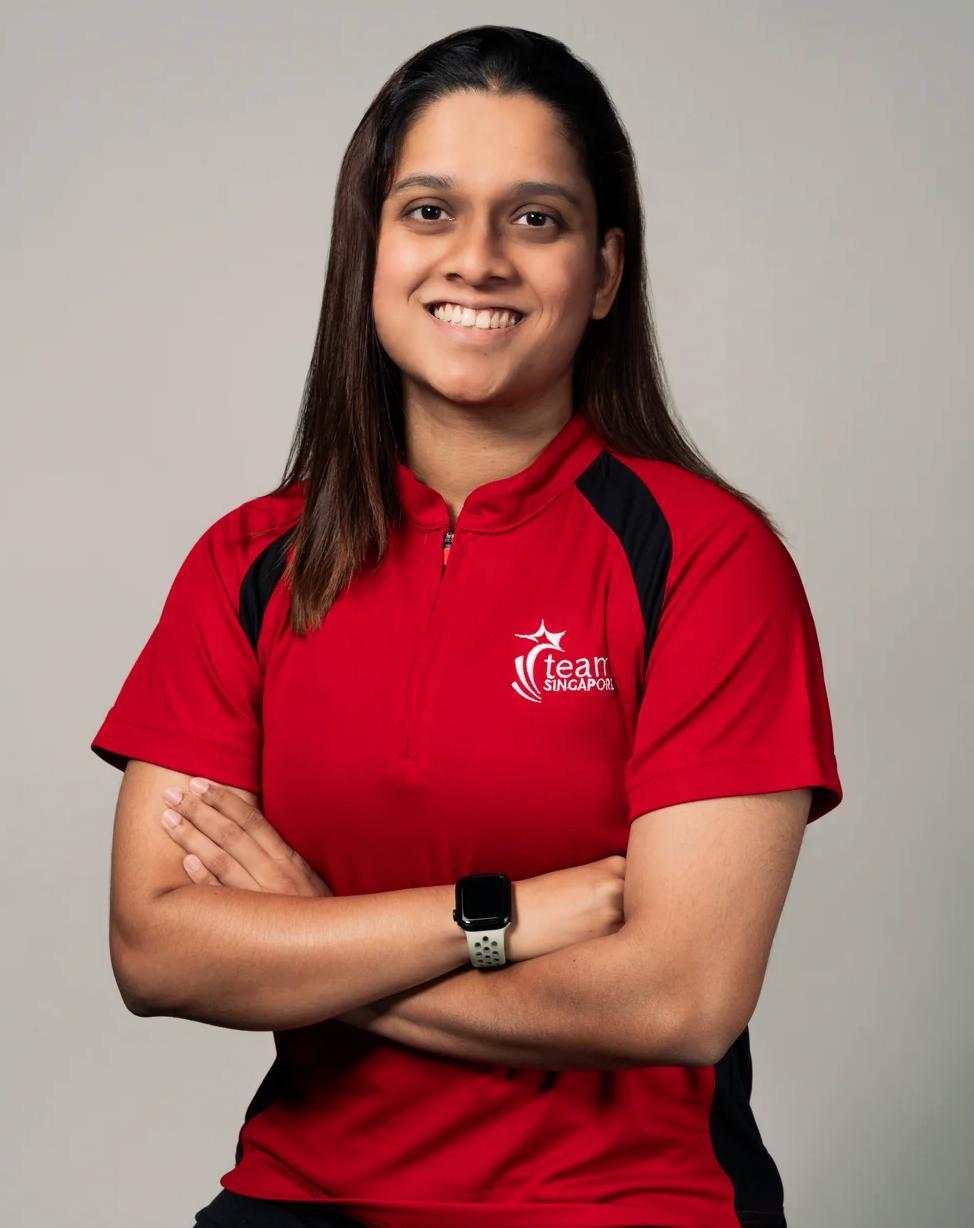
Lilian and Winnie are the two women on our roster who list pre or postnatal training, and they lead the coach cards on this page. If you would rather train with a woman, say so when you message us and we only match you with women; see our female personal trainer page. Whoever you choose, ask these before you book:
- Do they ask about your birth, not only the date? Vaginal or caesarean, tearing, blood loss and how pregnancy went all change the first block.
- Do they screen for red flags and stop the session for them, rather than reassure you?
- Will they work with your physio's notes, and refer you when something is outside their scope?
- Do they say plainly that they cannot diagnose diastasis or check your pelvic floor internally? A coach who claims otherwise is overstepping.
- Do they put pelvic floor and strength before impact, and hold running until at least 12 weeks?
What does a postnatal personal trainer cost in Singapore?
Each coach sets their own rate per 60-minute 1-to-1 session. On 2 October 2026 the women who list pre or postnatal training charged S$65 (Lilian) and S$120 (Winnie), and two men holding postpartum qualifications charged S$160-S$180 and S$210. Across our whole roster most sessions are S$80-S$130, median S$90 (October 2026). Your first session is a paid trial at 10% off your coach's rate, and packs of 10, 15 or 20 sessions take 5%, 10% or 15% off.
| Format | With Lilian | With Winnie |
|---|---|---|
| 1-to-1 | S$520 (S$65 x 8) | S$960 (S$120 x 8) |
| First trial session (10% off) | S$58.50 | S$108 |
| Pair, per person per session | S$55 | S$100 (S$200 for two) |
| Small group of 3-4, per person per session | S$45 | S$80 |
Rates change, so we confirm the figure in writing before you book; the live numbers are on the pricing page. To start, get matched and tell us how many weeks it has been since birth, what kind of birth it was and what your doctor said at the review.
What a postnatal trainer will not do
- Diagnose or clear you. Your doctor clears you to train; a women's health physio assesses your pelvic floor and abdominal wall. A coach works inside what they say.
- Promise a body or a date. We will not sell you a 'snap back' timeline.
- Train through a red flag. Any symptom in the table above ends the session.
- Rush impact. Running and jumping wait until at least 12 weeks and a symptom-free screen.
If you are still pregnant, start with prenatal personal training and the trimester guide. After a caesarean, read caesarean recovery exercise next.