

Self-check14 min read · Updated
Senior Fitness Tests You Can Do at Home
- Trial 10% off
- No membership
- WhatsApp reply, usually within the hour
The short answer
Do the CDC's three STEADI tests with someone beside you.
- In the 30-second chair stand, below average at ages 65-69 is fewer than 12 stands for men and fewer than 11 for women.
- In the Timed Up and Go, 12 seconds or more means a risk of falling.
- In the 4-stage balance test, not holding a heel-to-toe stance for 10 seconds means a higher risk.
- A score in the risk range is a reason to see a GP or polyclinic doctor, and Singapore has programmes such as HPB's Steady Lah and SportSG's CALM.
- About a third of people in Singapore aged 60 and above have fallen more than once (HealthHub).
Written by the Fit Titans coaching team. Edited by Theon. How we write guides
On this page (12)
- 1. Which fitness tests can a senior do safely at home?
- 2. Who should see a doctor before trying these tests?
- 3. How do you set up the tests safely at home?
- 4. How do you do the 30-second chair stand test?
- 5. What is a below-average chair stand score for your age?
- 6. How do you do the Timed Up and Go test, and what time is risky?
- 7. How do you do the 4-stage balance test?
- 8. What do your results mean, and what should you do next?
- 9. What is the Rikli and Jones Senior Fitness Test?
- 10. How common are falls among older adults in Singapore?
- 11. Which Singapore programmes help if you score in the risk range?
- 12. When does a coach help after the tests?
Key facts
- More than one in four adults aged 65 and over falls each year, and fewer than half tell their doctor (CDC)
- About one-third of people in Singapore aged 60 and above have fallen more than once, and fall injuries happen mostly at home (HealthHub)
- 30-Second Chair Stand: below average at ages 70-74 is fewer than 12 stands for men and fewer than 10 for women (CDC STEADI, 2017)
- Timed Up and Go: an older adult who takes 12 seconds or more to stand, walk 3 metres, turn, walk back and sit is at risk of falling (CDC)
Which fitness tests can a senior do safely at home?
Three, from the CDC's STEADI programme (Stopping Elderly Accidents, Deaths and Injuries), which US healthcare providers use to screen adults aged 65 and over for fall risk. Each needs a chair, a timer and a second person, and none takes more than a minute to run.
| Test | What it checks | You need | Risk sign (CDC) |
|---|---|---|---|
| 30-Second Chair Stand | Leg strength and endurance | A straight-backed chair without armrests, seat about 43 cm (17 in) high, and a timer | Fewer stands than the below-average score for your age and sex |
| Timed Up and Go (TUG) | Mobility: standing up, walking, turning and sitting | A standard chair with arms, a line on the floor 3 metres away, and a timer | 12 seconds or more |
| 4-Stage Balance Test | Static balance | A timer and a clear floor | Cannot hold the heel-to-toe (tandem) stance for 10 seconds |
These are screening tests. A score in the risk range does not mean you will fall, and a good score does not mean you will not. What a risk-range score does mean is that a doctor should look for the reasons. The CDC's STEADI algorithm lists medicines, blood pressure on standing, eyesight, feet and footwear, and home hazards alongside strength, gait and balance.
Who should see a doctor before trying these tests?
Skip the tests and see a GP or polyclinic doctor first if any of these apply to you or the parent you are testing. This page is general information for screening at home. It is not a diagnosis and does not replace a medical assessment.
- 01A fall in the past year,Especially one with an injury or one you could not get up from. The CDC treats any fall in the past year as a reason for a fall-risk assessment, and the NHS says to see a GP after a fall or if you are worried about your balance.
- 02Dizziness, light-headedness or fainting,Including when you stand up.
- 03Chest pain or pressure, or breathlessnessWith light effort.
- 04Heart disease, diabetes or high blood pressureHealthHub advises checking with your doctor before starting new exercise with conditions like these. For blood pressure, exercising with high blood pressure covers what to ask.
- 05A recent fracture, joint replacement or other surgery,Unless your surgeon's team has cleared you to stand and walk without support.
- 06Feeling unwell todayHealthHub's advice is not to exercise until you have fully recovered.
During any test, stop at once for pain or pressure in the chest, neck, shoulders or arms, sharp joint pain, dizziness or nausea, or a cold sweat. Those are HealthHub's stop signs for older adults.
Call 995 for breathlessness, loss of consciousness or signs of a stroke, which are among the emergencies the SCDF lists. If someone falls and may have hurt their head, back, neck or hip, or cannot get up, the NHS advice is to call an ambulance.
How do you set up the tests safely at home?
- 01Have someone stand beside youEvery CDC form tells the tester to stand next to the person for safety. In the balance test the helper holds your arm while you get into each position, lets go when you are steady, and stays ready.
- 02Put the chair against a wallSo it cannot slide back, on a dry floor. Move rugs, cords and clutter away: HealthHub lists slippery floors, loose rugs and cords and unsuitable footwear among the hazards behind falls at home.
- 03Wear your usual walking shoes,Not slippers or socks. The CDC's TUG form says to wear regular footwear and to use a walking aid if you normally do.
- 04Use a sturdy chair with a backrestNo folding chairs, stools or anything on wheels. The chair stand uses a straight-backed chair without armrests. The TUG uses a chair with arms.
- 05Pick a time when you feel well,Not straight after a heavy meal or in the afternoon heat. In a non-air-conditioned flat, morning is easier.
- 06Write down the scores and the date,Because the value is in repeating the tests and comparing.
How do you do the 30-second chair stand test?
It measures leg strength and endurance: the strength you use to get out of a chair, off the toilet or up the steps at an MRT exit. The method below is from the CDC's 30-Second Chair Stand form.
- 01Sit in the middle of the chair,Feet flat on the floor, back straight.
- 02Cross your arms at the wristsWith your hands on the opposite shoulders and your arms against your chest.
- 03On "Go", stand up fully,Then sit back down. Repeat as many times as you can in 30 seconds.
- 04The helper counts each full standIf you are more than halfway up when the 30 seconds end, it counts.
- 05If you need your arms to push up, stopThe CDC records that as 0, which is useful information, not a failure.
Go at a pace you can control. Dropping into the seat to save time is how people lose their balance on the way down, and a careful 10 tells you more than a reckless 13.
What is a below-average chair stand score for your age?
The CDC form gives the score below which a result counts as below average, by age and sex, and says a below-average score indicates a risk for falls.
See the full table
| Age | Men: below average if fewer than | Women: below average if fewer than |
|---|---|---|
| 60-64 | 14 stands | 12 stands |
| 65-69 | 12 stands | 11 stands |
| 70-74 | 12 stands | 10 stands |
| 75-79 | 11 stands | 10 stands |
| 80-84 | 10 stands | 9 stands |
| 85-89 | 8 stands | 8 stands |
| 90-94 | 7 stands | 4 stands |
These cut-offs sit at the bottom of the normal ranges that Rikli and Jones published for the same test, where normal means the middle 50% of people that age.
For men aged 60-64, their normal range is 14 to 19 stands and the CDC's cut-off is fewer than 14, so a below-average score puts you in roughly the lowest quarter for your age and sex. A related test, the five-time chair stand, is timed rather than counted. It is covered in our sarcopenia guide.
How do you do the Timed Up and Go test, and what time is risky?
The TUG checks mobility: standing, walking, turning and sitting down, the moves behind getting to the door when the bell rings. The steps are from the CDC's Timed Up and Go form.
- 01Mark a line 3 metres (10 feet) from the chairWith masking tape. Measure it with a tape measure rather than pacing it out.
- 02Sit back in a standard chair with arms,In your usual shoes, with your walking stick or frame if you use one.
- 03On "Go", the helper starts the timerStand up, walk to the line at your normal pace, turn, walk back and sit down.
- 04The helper stops the timerWhen you are seated again, and stays by your side throughout.
The CDC's cut-off is simple: an older adult who takes 12 seconds or more to complete the TUG is at risk of falling. The time is only half of it.
The form also asks the tester to watch for a slow, hesitant pace, loss of balance, short strides, little or no arm swing, steadying on the walls, shuffling, turning the whole body in one block, and not using a walking aid properly, and it notes these can be signs of neurological problems that need a doctor's look. A quick time with a shuffle is still worth telling your GP about.
The Rikli and Jones battery has a shorter version, the 8-foot up-and-go over 2.44 metres, with a risk zone of more than 9 seconds. The two are not interchangeable, so retest with the same distance each time.
How do you do the 4-stage balance test?
It checks static balance in four standing positions that get harder, as set out on the CDC's 4-Stage Balance Test form. Hold each for 10 seconds without moving your feet or holding on.
You may hold your arms out or move your body to stay balanced. Keep your eyes open and do not use a stick or frame. If you cannot hold a position for 10 seconds, stop there and do not try the next one.
- 01Stage 1: feet side by side
- 02Stage 2: semi-tandemThe instep of one foot touches the big toe of the other.
- 03Stage 3: tandemOne foot directly in front of the other, heel touching toe.
- 04Stage 4: one footStand on one leg.
Stand next to the wall or the back of the chair, with the helper beside you. The CDC's marker is stage 3: an older adult who cannot hold the tandem stance for at least 10 seconds is at increased risk of falling, and the CDC suggests physical therapy for gait and balance, or an evidence-based fall prevention programme such as Tai Chi.
What do your results mean, and what should you do next?
| Result | What it suggests | Next step |
|---|---|---|
| None of the three in the risk range, no fall in the past year | Lower risk for now | Keep up strength and balance work at least 3 days a week and retest in a year |
| Chair stand below average for your age | Leg strength is the weak point | Progressive leg strength work, two or more days a week |
| TUG 12 seconds or more, or a shuffle, sway or steadying on walls | At risk of falling (CDC) | See a GP or polyclinic doctor. Ask about a falls assessment, a medicine review and physiotherapy |
| Could not hold the tandem stance for 10 seconds | Increased fall risk (CDC) | Ask for physiotherapy for gait and balance, or join a fall prevention programme |
| Any fall in the past year, whatever the scores | At risk under the CDC's screening rule | See a doctor before starting a new programme |
| Needed arms to stand, or could not do a test at all | A clear sign to get help | See a doctor first and train only with supervision |
The CDC also screens with three questions every year: have you fallen in the past year, do you feel unsteady when standing or walking, and do you worry about falling. A yes to any one is worth a fuller assessment, whatever the test scores say, and the CDC rescreens yearly or any time after a fall.
Singapore's physical activity guidelines for adults 65 and above set the training dose: muscle-strengthening on 2 or more days a week, multicomponent activity that stresses strength and balance on at least 3, and 150 to 300 minutes of moderate aerobic activity a week.
The exercises that train these scores are in fall-prevention exercises for seniors: sit-to-stands, step-ups and balance holds with a wall nearby. For heavier strength work, strength training after 50 covers how to load safely.
What is the Rikli and Jones Senior Fitness Test?
It is the fuller battery the chair stand comes from. Roberta Rikli and Jessie Jones developed the Senior Fitness Test at California State University, Fullerton, to measure the physical capacities older adults need for everyday independence.
As their 2002 summary describes it, the battery has six items plus one alternative: the 30-second chair stand for leg strength, a 30-second arm curl with a light dumbbell for upper-body strength, a 6-minute walk for aerobic endurance (or a 2-minute step test where space or weather rules the walk out), a chair sit-and-reach for lower-body flexibility, a back scratch reach for shoulder flexibility, and the 8-foot up-and-go for agility and dynamic balance.
In 2013 the same authors published fitness standards for the battery in The Gerontologist, built from the scores of 2,140 older adults and set out for men and women aged 60 to 94, aimed at the level of fitness needed to stay physically independent into late life.
Their earlier summary gives risk zones such as fewer than 8 unassisted chair stands in 30 seconds. The full battery needs space for the walk and the published manual to score it, so it suits a trained tester better than a living room. The three CDC tests are the home version.
How common are falls among older adults in Singapore?
Common, and mostly at home. HealthHub, in a page by HPB, says about one-third of people in Singapore aged 60 and above have fallen more than once, that the risk rises with age, and that fall-related injuries happen mostly at home.
When HPB launched its first falls prevention campaign in 2016, MOH said about 8,000 seniors a year had been admitted to hospital because of falls over the previous three years, about 2,000 had been admitted for hip fractures the year before, and 63% of seniors' falls happened at home. Those 2016 figures are the latest national admission numbers we found on MOH's site.
The US picture is similar. The CDC says more than one in four adults aged 65 and over falls each year and fewer than half tell their doctor, and its STEADI guide calls falls the leading cause of injury death for older adults. Because so many falls go unmentioned, the CDC asks about them every year.
HealthHub's risk factors make a useful checklist: weaker muscles and poorer balance, conditions such as Parkinson's disease, cataracts, high blood pressure and stroke, medicines such as sedatives and blood pressure drugs, low activity, fatigue and poor nutrition. MOH adds that seniors on long-term medication should have a doctor review it at least once a year, because several medicines taken together can cause dizziness.
Which Singapore programmes help if you score in the risk range?
- 01HPB's Steady Lah,A targeted programme built on progressive muscle strengthening. MOH told Parliament in a 6 May 2026 reply that HPB's targeted programmes and SportSG's CALM had drawn more than 25,000 seniors over five years, that about seven in ten seniors in HPB's programmes improved in strength, flexibility and gait speed, and that HPB and SportSG plan to reach another 10,000 seniors by the end of 2026.
- 02SportSG's CALM (Combat Age-related Loss of Muscle),For adults aged 60 and above. CALM 1.0 is 8 weekly 60-minute sessions at an Active Health lab, with grip strength, walking speed and muscle mass measured in weeks 1 and 8. In CALM, 85% of participants improved in at least three of five measurements, according to the same MOH reply.
- 03Age Strong on the Healthy 365 app,With customised workouts and falls prevention tips for seniors who prefer to train on their own.
- 04Live Well, Age Well,Run by HPB and the People's Association for Singaporeans aged 50 and above, with weekly group exercise for strength, balance and flexibility in the community. MOH said in February 2025 that seniors would be served by 220 Active Ageing Centres by 2025, with activities including exercise.
- 05Polyclinic physiotherapySingHealth Polyclinics run exercise classes for patients at high risk of falls, and vestibular rehabilitation for dizziness and balance problems, on a doctor's referral.
- 06Home changesHDB's Enhancement for Active Seniors (EASE) programme subsidises changes such as bathroom grab bars, which MOH pointed seniors to when it launched the 2016 falls campaign.
If you are arranging help for a parent, our guide for adult children covers how to set up and brief a coach, and physio or personal trainer explains who to see after an injury.
When does a coach help after the tests?
Once a doctor has cleared training, the tests become a progress check. A coach can run the chair stand, the TUG and the balance test in the first session at home, use the weakest result to shape the programme, and repeat the tests every few weeks so you and your doctor can see whether the numbers move.
A Fit Titans coach is a trainer, not a physiotherapist or doctor, so a new fall, new dizziness or new pain goes back to your GP.
Coaches are verified, meaning we checked the certification against the issuing body, matched experience to the goal, followed up references and assessed their coaching in person, and they come to your home, condo gym, a park or a Gym Pod, with no membership.
Each coach sets their own rate: most charge S$80-S$130 for a 60-minute 1-to-1 session (median S$90, full range S$50-S$210, measured October 2026). The first session is a paid trial at 10% off.
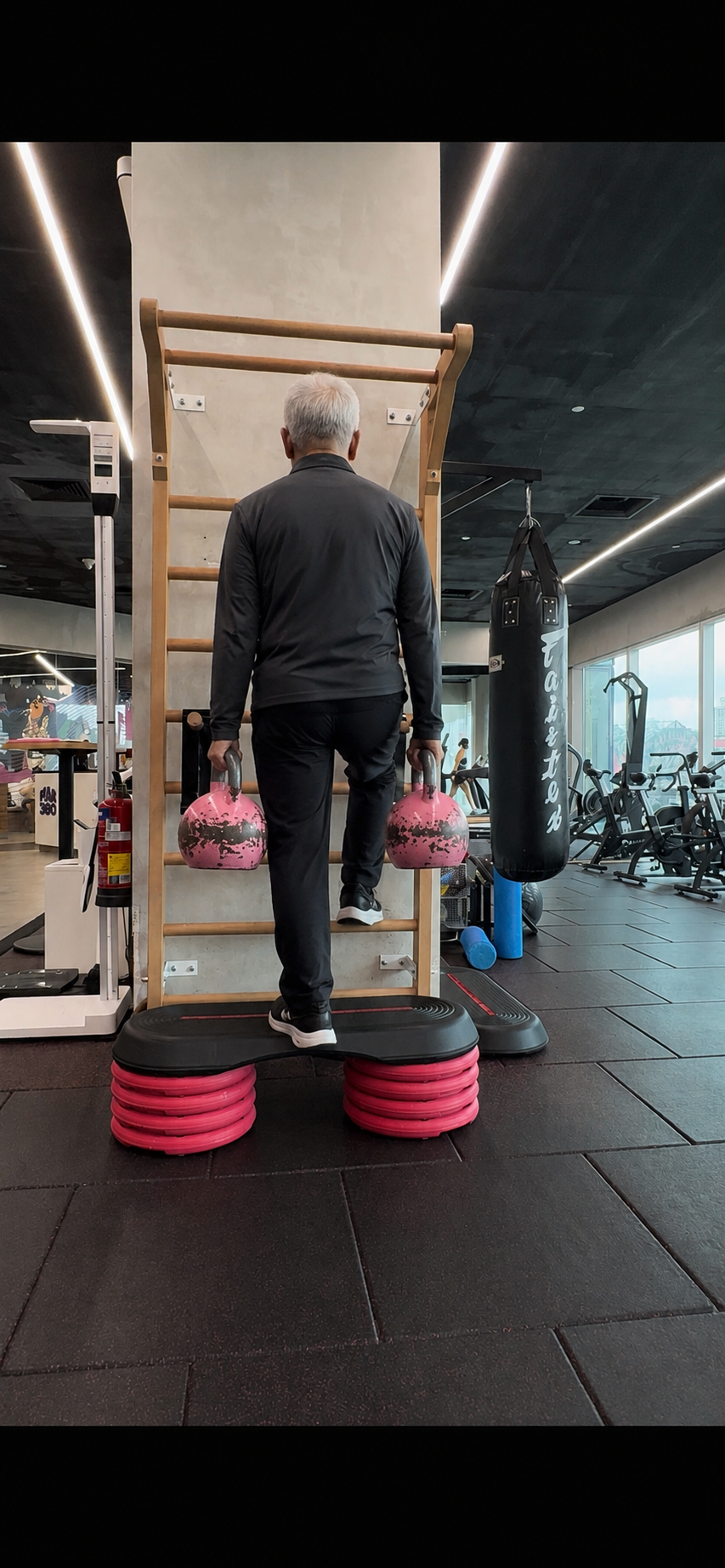
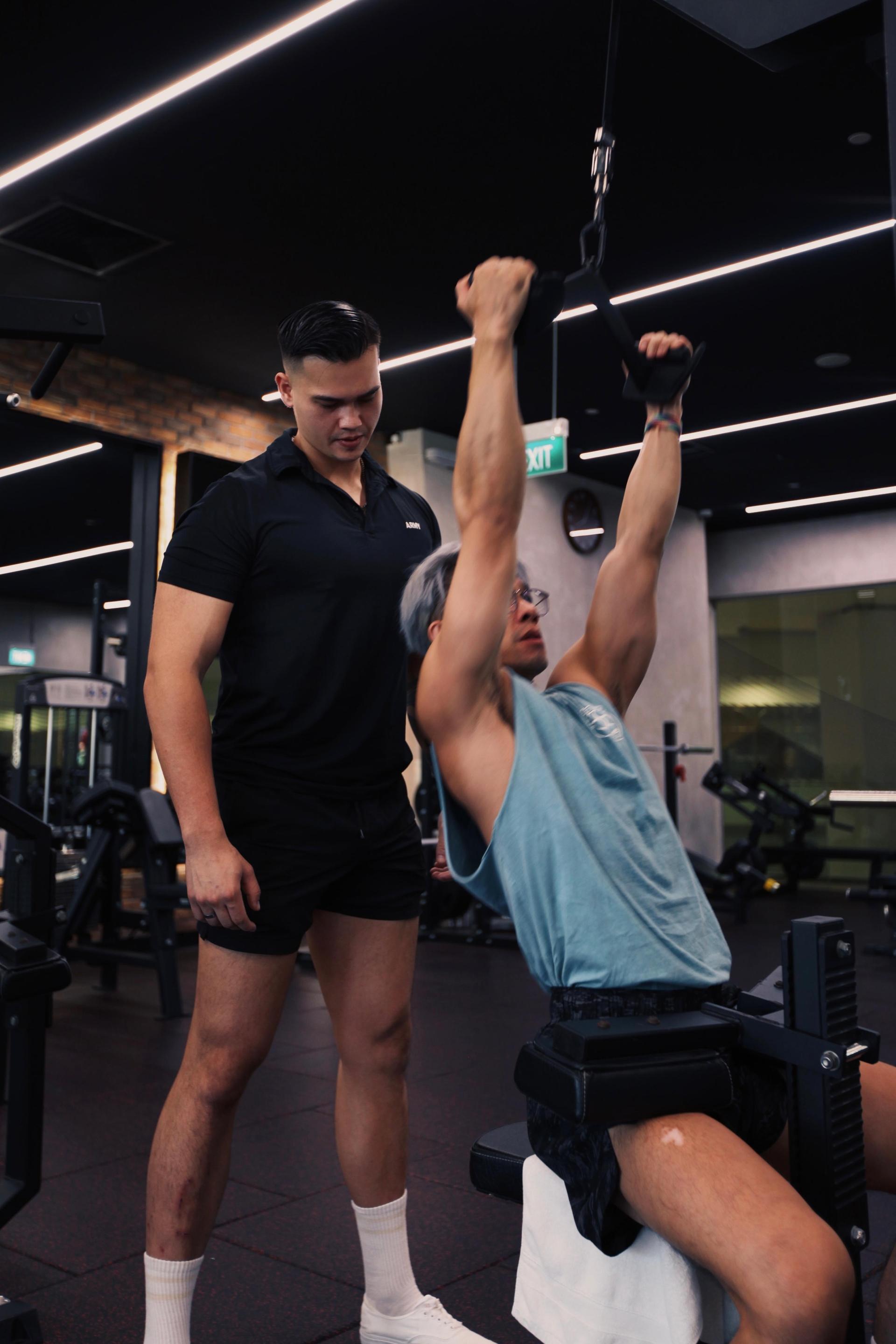
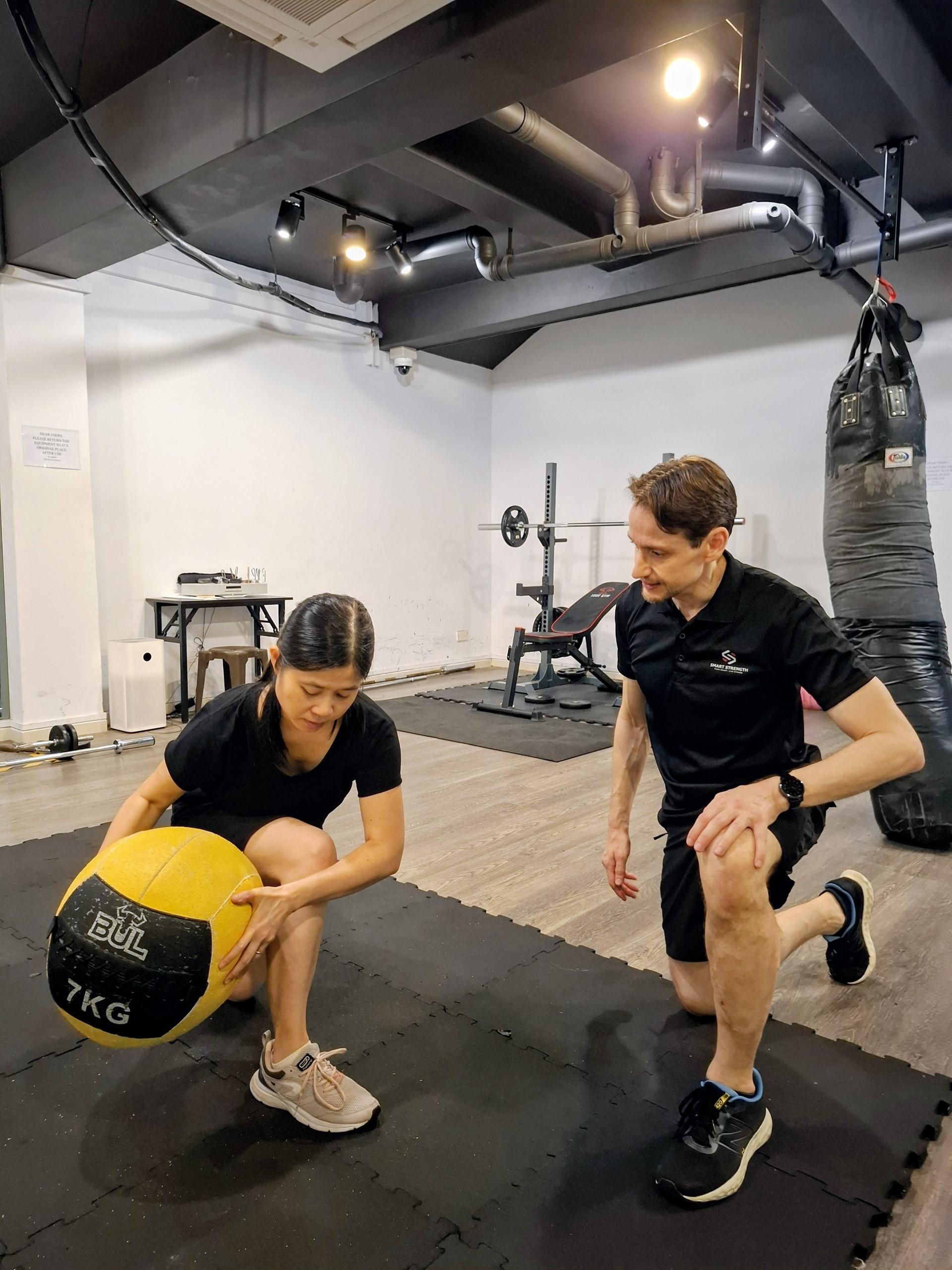
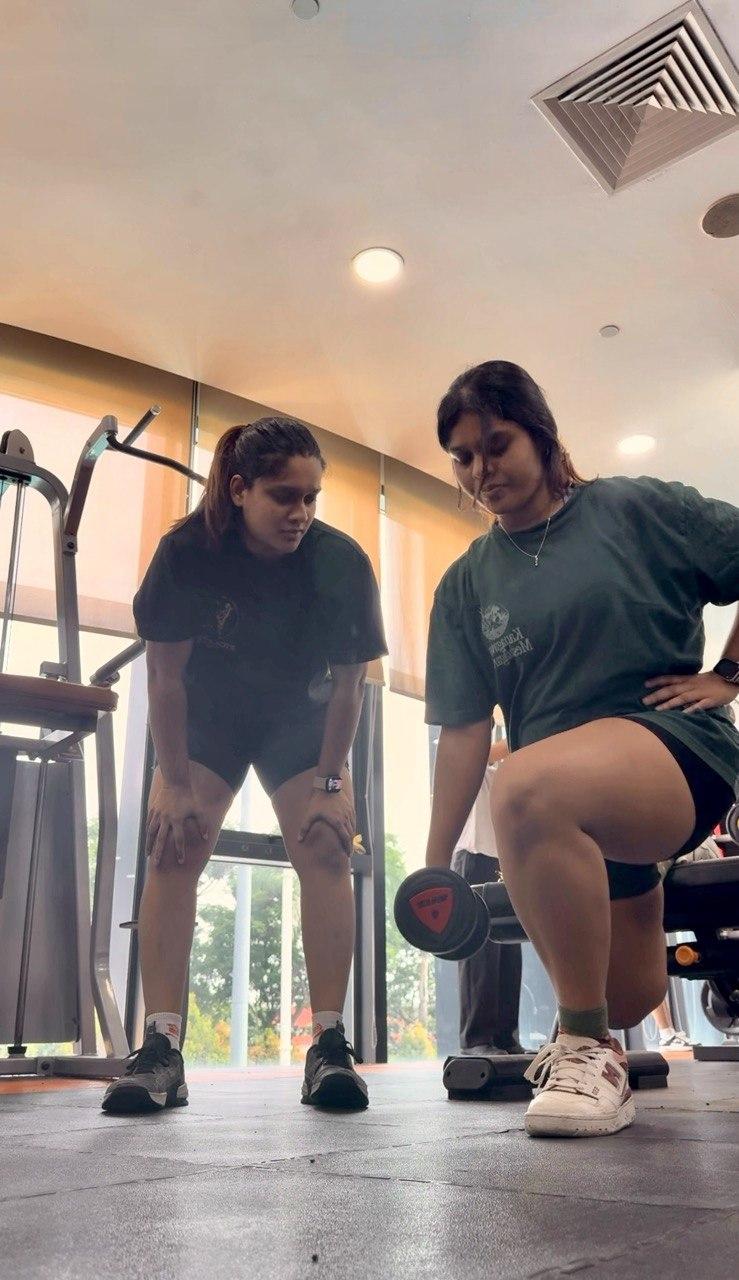
Our coaches at work
Real sessions from our coaches' own galleries. Swipe for more.
Senior fitness tests questions.
What is a good 30-second chair stand score for a 70-year-old?
For ages 70-74 the CDC counts fewer than 12 stands as below average for men and fewer than 10 for women. Rikli and Jones's normal range for that age, the middle 50% of people, is 12 to 17 stands for men and 10 to 15 for women. A score above the top of that range is above average for your age.
Is a Timed Up and Go time of 12 seconds bad?
The CDC says an older adult who takes 12 seconds or more to complete the TUG is at risk of falling. That is a reason to see a GP or polyclinic doctor for a fuller falls assessment, not a diagnosis. Watch how the walk looks as well: shuffling, short strides or steadying on furniture matter even with a quicker time.
Can a senior do these tests alone?
Not safely. The CDC forms tell the tester to stand beside the person throughout, and in the balance test to hold their arm until they are steady. Ask a family member to help, and put the chair against a wall on a dry floor.
How often should seniors repeat fitness tests?
The CDC's STEADI algorithm screens adults aged 65 and over once a year, and again any time after a fall. If you are training to improve a score, retesting every few weeks shows whether it is working. Use the same chair, the same 3-metre line and the same time of day so the numbers compare.
Where can seniors in Singapore get a proper falls assessment?
Start with a GP or polyclinic doctor. The CDC's assessment covers medicines, blood pressure on standing, eyesight and feet as well as strength and balance, so ask about each. SingHealth Polyclinics run exercise classes for patients at high risk of falls, on referral. SportSG's CALM programme for adults aged 60 and above measures grip strength, walking speed and muscle mass at its Active Health labs.
Can someone who uses a walking stick do these tests?
Partly. The CDC's TUG form allows your usual walking aid. The balance test is done without a stick or frame, so if you cannot stand without one, skip it and tell your doctor. In the chair stand, needing your arms to stand up is scored as 0.

About this guide
Published
Terms used
- HPB:
- Health Promotion Board, the government agency behind Singapore's public health guidance, including physical activity recommendations and the national effort on diabetes.
Sources
- STEADI assessment: 30-Second Chair Stand, 2017 (read 26 Oct 2026) · Centers for Disease Control and Prevention
- STEADI assessment: Timed Up and Go (TUG), 2017 (read 26 Oct 2026) · Centers for Disease Control and Prevention
- STEADI assessment: The 4-Stage Balance Test, 2017 (read 26 Oct 2026) · Centers for Disease Control and Prevention
- STEADI pocket guide and algorithm: preventing falls in older patients, 2019 (read 26 Oct 2026) · Centers for Disease Control and Prevention
- Older adult falls: facts and stats (read 26 Oct 2026) · Centers for Disease Control and Prevention
- Combating falls (read 26 Oct 2026) · HealthHub / Health Promotion Board
- 7 easy exercises to an active lifestyle (read 26 Oct 2026) · HealthHub
- Singapore Physical Activity Guidelines for older adults, 65 years and above (read 26 Oct 2026) · HealthHub / Health Promotion Board
- Speech at HPB's launch of the Falls Prevention Awareness Campaign, 9 Jul 2016 (read 26 Oct 2026) · Ministry of Health
- Participation rates of seniors in fall risk prevention programmes, 6 May 2026 (read 26 Oct 2026) · Ministry of Health
- Promoting awareness of and preventive measures against sarcopenia, 4 Feb 2025 (read 26 Oct 2026) · Ministry of Health
- Seniors and falls, 5 May 2020 (read 26 Oct 2026) · Ministry of Health
- Combat Age-related Loss of Muscle (CALM 1.0) (read 26 Oct 2026) · Sport Singapore / Active Health
- Physiotherapy services (read 26 Oct 2026) · SingHealth Polyclinics
- Falls (read 26 Oct 2026) · NHS
- SCDF emergency medical services (read 26 Oct 2026) · Singapore Civil Defence Force
- Rikli and Jones, criterion-referenced fitness standards for maintaining physical independence in later years, The Gerontologist 53(2), 2013 (read 26 Oct 2026) · Oxford University Press
- Jones and Rikli, Measuring functional fitness of older adults, The Journal on Active Aging, Mar-Apr 2002, copy hosted by the University of Verona (read 26 Oct 2026) · The Journal on Active Aging
General information, not medical advice.