

Fitness numbers12 min read · Updated
Healthy Body Fat Percentage by Age
- Trial 10% off
- No membership
- WhatsApp reply, usually within the hour
The short answer
For Asian adults, Gallagher et al.
- (American Journal of Clinical Nutrition, 2000) put healthy body fat, the range that matches a BMI of 18.5 to 25, at about 25-35% for women and 13-23% for men aged 20 to 39, and 25-36% and 14-24% at 60 to 79.
- Singapore uses lower BMI lines for Asians (23 and 27.5, HPB-MOH) because people here carry more fat at the same BMI.
- An InBody reads about 3 points lower than DEXA on average (Lahav et al., 2021).
- DEXA body composition scans in Singapore were listed from S$120 before GST on 26 October 2026.
Written by the Fit Titans coaching team. Edited by Theon. How we write guides
On this page (12)
- 1. What is a healthy body fat percentage for your age?
- 2. Why do Asians carry more body fat at the same BMI?
- 3. Why does Singapore use lower BMI cut-offs?
- 4. What body fat percentage is too high, and what is too low?
- 5. How accurate is an InBody compared with a DEXA scan?
- 6. How do water, food and exercise skew an InBody reading?
- 7. Where can you get a DEXA body composition scan in Singapore?
- 8. Should you choose an InBody or a DEXA scan?
- 9. How often should you measure your body fat?
- 10. What should you track instead of body fat percentage?
- 11. When should you see a doctor about body fat or weight?
- 12. How does a Fit Titans coach fit in?
Key facts
- Gallagher et al. (2000) derived healthy body fat ranges from 1,626 adults measured with reference methods. Asian women aged 20-39 had a healthy range of 25-35% and Asian men 13-23%
- All of Gallagher's Asian participants were Japanese adults measured in Japan, and the ranges sit on the international BMI 25 line, not Singapore's 23
- Singaporean Chinese and Malays at a BMI of about 27 carried the body fat of Caucasians at 30, and Indians at about 26 (Deurenberg-Yap et al., 2000)
- HPB-MOH treats a BMI of 23.0-27.4 as moderate risk and 27.5 or more as high risk, with waist cut-offs of 90 cm for men and 80 cm for women
What is a healthy body fat percentage for your age?
For Asian women it is about 25-35% at any adult age, and for Asian men about 13-24%, rising slightly with age. Those figures come from Gallagher and colleagues in the American Journal of Clinical Nutrition in 2000.
They measured 1,626 adults of white, African American and Asian background with reference methods (a four-compartment model and DEXA), then worked out how much body fat matches the international BMI lines: 18.5 (underweight), 25 (overweight) and 30 (obesity). The body fat that matches a BMI of 18.5 to 25 is the healthy range.
| Group | Age 20-39 | Age 40-59 | Age 60-79 |
|---|---|---|---|
| Asian women: healthy range | 25-35% | 25-35% | 25-36% |
| Asian women: obesity level | 40% or more | 41% or more | 41% or more |
| Asian men: healthy range | 13-23% | 13-24% | 14-24% |
| Asian men: obesity level | 28% or more | 29% or more | 29% or more |
| White and African American women: healthy range | 21-33% | 23-34% | 24-36% |
| White and African American men: healthy range | 8-20% | 11-22% | 13-25% |
Three things to know before you use it. Women's ranges sit about 10 to 12 points above men's at every age, so never compare across sexes. All of the Asian participants were Japanese adults measured at Jikei University in Japan, so the Asian rows are the closest published fit for Singapore, not a Singapore study.
And the ranges sit on the international BMI 25 line. Singapore's health authorities start counting risk at 23, which suggests the top of each healthy range may be generous for people here.
Why do Asians carry more body fat at the same BMI?
Differences in body build, according to the Singapore study below. Gallagher's model found Asians had a significantly higher body fat percentage than the other two groups at any given BMI, particularly at younger ages. A Singapore study made the point sharper.
Deurenberg-Yap and colleagues measured 291 Chinese, Malay and Indian adults in Singapore with a four-compartment model in 2000, and found that equations built on Caucasians underestimated their body fat by 2.7 to 5.6 points.
At the same BMI, Indians had the most body fat and Chinese the least. A Caucasian at a BMI of 30 carried the same body fat as a Singaporean Chinese or Malay at about 27, and a Singaporean Indian at about 26.
Why does Singapore use lower BMI cut-offs?
Because the same health risk arrives at a lower BMI here. The HPB-MOH clinical practice guidelines on obesity note that WHO and international guidelines use 25 and 30 for overweight and obesity, and recommend 23 and 27.5 as the lines for public health action in Asians, based on body fat equivalence and disease risk. The Singapore Heart Foundation's BMI calculator uses the same Asian bands:
| BMI (kg/m2) | Singapore risk band | International label (WHO) |
|---|---|---|
| Below 18.5 | Underweight: risk of nutritional deficiency and osteoporosis | Underweight |
| 18.5-22.9 | Low risk (healthy range) | Healthy |
| 23.0-27.4 | Moderate risk | Healthy up to 24.9, overweight from 25 |
| 27.5 and above | High risk | Overweight up to 29.9, obese from 30 |
The guidelines pair BMI with waist size, calling waist circumference the most practical measure of abdominal fat before and during weight loss. International cut-offs are 102 cm for men and 88 cm for women. For Asians the guidelines suggest 90 cm and 80 cm. The Heart Foundation adds that BMI should not be used to judge risk in pregnant women, people with a muscular build or the elderly.
For muscular and older adults, a body fat or muscle measurement tells you more. For scale, HealthHub, which counts obesity at the international BMI of 30, reports that 11.6% of residents aged 18 to 74 were obese in 2022, up from 10.5% in 2019/2020 (National Population Health Survey).



What body fat percentage is too high, and what is too low?
Using Gallagher's Asian rows, body fat of 40-41% or more in women and 28-29% or more in men matches the international obesity line of BMI 30, and anything above the healthy range matches overweight. Because Singapore's risk lines sit lower, it is reasonable to treat the upper end of the healthy range as a warning zone rather than a target.
At the other end, body fat below the bottom of the range (25% for Asian women, 13-14% for Asian men) matches a BMI under 18.5, the band the Heart Foundation links with nutritional deficiency and osteoporosis.
The ranges are population guides built from BMI, so a very muscular person can sit outside them. For most people, though, a reading below the range is not a goal. If you have reached it by dieting hard, talk to a doctor.
How accurate is an InBody compared with a DEXA scan?
An InBody is consistent with itself but tends to read lower than DEXA. An InBody sends a small electrical current through your body and estimates fat from how easily it passes (bioimpedance). DEXA (dual-energy X-ray absorptiometry) scans you with low-dose X-rays at two energies to separate fat, muscle and bone, and Gallagher's team used it as one of their reference methods. The studies line up like this:
- 01Repeatable, but biasedIn McLester et al. (Journal of Clinical Densitometry, 2020), 67 healthy adults tested on three InBody models twice, 24 to 72 hours apart. Reliability was excellent (intraclass correlation of 0.98 or more for body fat), but every model underestimated body fat compared with DEXA. The smallest change that could be told apart from noise was 2.1 to 2.7 percentage points of body fat.
- 02About 3 points low, more in lean peopleIn Lahav et al. (European Journal of Clinical Nutrition, 2021), 226 adults aged 18 to 80, an InBody 770 read 3.1 points below DEXA on average, with individual differences from 2.6 above to 8.9 below. Its errors were largest in normal-weight participants.
- 03Not good enough for one person with obesityIn Nickerson et al. (2020), 50 adults with obesity, two InBody models agreed with each other, but individual readings fell up to about 5 points either side of DEXA, which the authors judged not acceptable for individual estimates.
- 04DEXA has error too, but lessIn Kutáč et al. (PLOS ONE, 2019), the typical error of a repeat whole-body DEXA scan in college students was 0.44 percentage points of body fat in women and 0.66 in men.
So an InBody is fine for watching your own trend under the same conditions, and poor for comparing yourself with a chart built on DEXA. If your InBody says 22% and you are an Asian man, the DEXA figure could plausibly be a few points higher.
How do water, food and exercise skew an InBody reading?
By 1 to 3 points in the studies below, about the size of the smallest real change an InBody can detect. Bioimpedance depends on body water, so anything that shifts your water shifts the number. Jeong et al. (2023) had 39 adults drink 2 litres of water: multi-frequency bioimpedance body fat rose by 2.1 points in men and 2.6 in women.
Androutsos et al. (2015) found a meal or an electrolyte drink raised readings by about 1 point, small but measurable. And Dixon and Andreacci (2009) found an hour of resistance training lowered segmental bioimpedance body fat by 0.9 points in women and 1.4 in men. In Singapore, a sweaty commute or a run in the heat is an easy way to arrive at the machine with your water off.
InBody's own testing guidance sets the conditions that keep readings comparable:
- 01Wait at least 3 hours after your last meal,And use the toilet first.
- 02Drink normally the day before,And hydrate an hour before the test rather than gulping water at the machine.
- 03Test only once you have recovered from exercise,Which InBody puts at 1 to 3 days.
- 04Stand for 5 to 10 minutes first,Keep lotion off your hands and feet, and allow 20 minutes after heat or cold.
- 05Test at the same time of day every timeMorning, before breakfast, is the easiest slot to repeat.

Where can you get a DEXA body composition scan in Singapore?
At private clinics and screening centres. These providers list a DEXA body composition scan on their own pages. Prices are as published on 26 October 2026, with each page's GST basis:
| Provider | What the page says | Published price |
|---|---|---|
| Advantage Medical, Bukit Timah | DEXA body composition: how much is fat, how much is muscle and where the fat sits | S$120 before GST, standalone |
| DA MedSuites, COMO Orchard | DEXA total body composition, including visceral fat and a skeletal muscle index. A doctor's referral or request form is needed outside a health screening | S$129 including GST |
| Singapore Women's Clinic, Camden Medical Centre | DEXA body composition, scanned at a partner radiology clinic at Shaw House. With visceral fat analysis S$308.47. The page does not say whether men can book | S$207.10 nett, including GST |
| DexaFit Singapore, Oxley Tower | DEXA body composition scan. First visit S$225. 5 scans for S$1,000 | S$300 before 9% GST |
| Active Health (ActiveSG) | Not DEXA: a 15-minute InBody 770 assessment with a printout, for ages 18 and up. Not for people with pacemakers or metal implants, or in pregnancy | Fee not stated on the page |
The radiation dose is small: Advantage Medical puts a whole-body scan at under 10 microsieverts, and Singapore Women's Clinic at less than a tenth of a chest X-ray. You do not need to fast, but tell the clinic if you are or might be pregnant.
Should you choose an InBody or a DEXA scan?
- 01Choose DEXAIf you want a figure you can hold against the ranges above, need visceral fat or a muscle mass figure, or are tracking muscle loss with age. The Asian Working Group for Sarcopenia's 2019 consensus uses DEXA or bioimpedance muscle mass in its diagnosis, as covered in our sarcopenia training guide.
- 02Choose an InBodyIf you want a cheap, frequent check of your own trend, and you can test under the same conditions each time.
- 03Never mix themA DEXA in January and an InBody in April will show a change that may be the machine, not you.
How often should you measure your body fat?
Less often than you think. InBody suggests testing every 2 to 4 weeks under the same conditions. Since McLester's study put the smallest real InBody change at 2.1 to 2.7 points, a monthly reading is plenty, and a change smaller than that between two readings may be noise.
DEXA is more precise, but each scan costs S$120 or more, so every 3 to 6 months is a sensible rhythm for most people, often enough to see a training block's effect.
What should you track instead of body fat percentage?
- 01WaistMeasure at the same spot, same time of day, every 2 weeks. The HPB-MOH guidelines call it the most practical measure of abdominal fat. Aim to stay under 90 cm for men and 80 cm for women. Our guide to losing belly fat covers the visceral fat behind that number.
- 02StrengthLog the weights and reps on your main lifts. Rising strength with a steady or falling waist means you are keeping muscle while losing fat, the pattern behind body recomposition.
- 03Grip and muscle as you ageThe Asian Working Group for Sarcopenia (2019) flags handgrip below 28 kg for men and 18 kg for women as low strength.
- 04PhotosSame light, same spot, same clothes, every 4 weeks. They catch changes the scale and the tape miss.
- 05Weekly average weightWeigh most mornings and look at the weekly average, not the daily swing.
When should you see a doctor about body fat or weight?
- Your BMI is 27.5 or more, or your waist is over 90 cm (men) or 80 cm (women). The HPB-MOH guidelines use these to identify raised disease risk, so ask your doctor to check blood pressure, blood sugar and cholesterol.
- You are losing weight without trying, or your body fat reading has fallen below the healthy range.
- Before an InBody, if you have a pacemaker or metal implant or are pregnant: Active Health says the assessment is not suitable for you.
- Before a hard new training plan, if you have heart symptoms, diabetes or high blood pressure.
A body fat number is a measurement, not a diagnosis, and no plan can promise a particular result.
How does a Fit Titans coach fit in?
A coach turns the tracking above into training: strength sessions to hold on to muscle while you lose fat, a waist and strength log reviewed every few weeks, and a check on whether the trend is real before anyone reacts to one reading. Coaches are not dietitians or doctors, so medical questions stay with your doctor.
Fit Titans matches you with a verified freelance coach who trains you at home, in your condo gym, at a park or at a Gym Pod, with no membership. Each coach sets their own rate: most charge S$80-S$130 for a 60-minute 1-to-1 session, the median is S$90 and the full range is S$50-S$210 (measured October 2026).
The first session is a paid trial at 10% off. For the goal itself, see weight-loss coaching or, if you want to add muscle, muscle gain coaching.
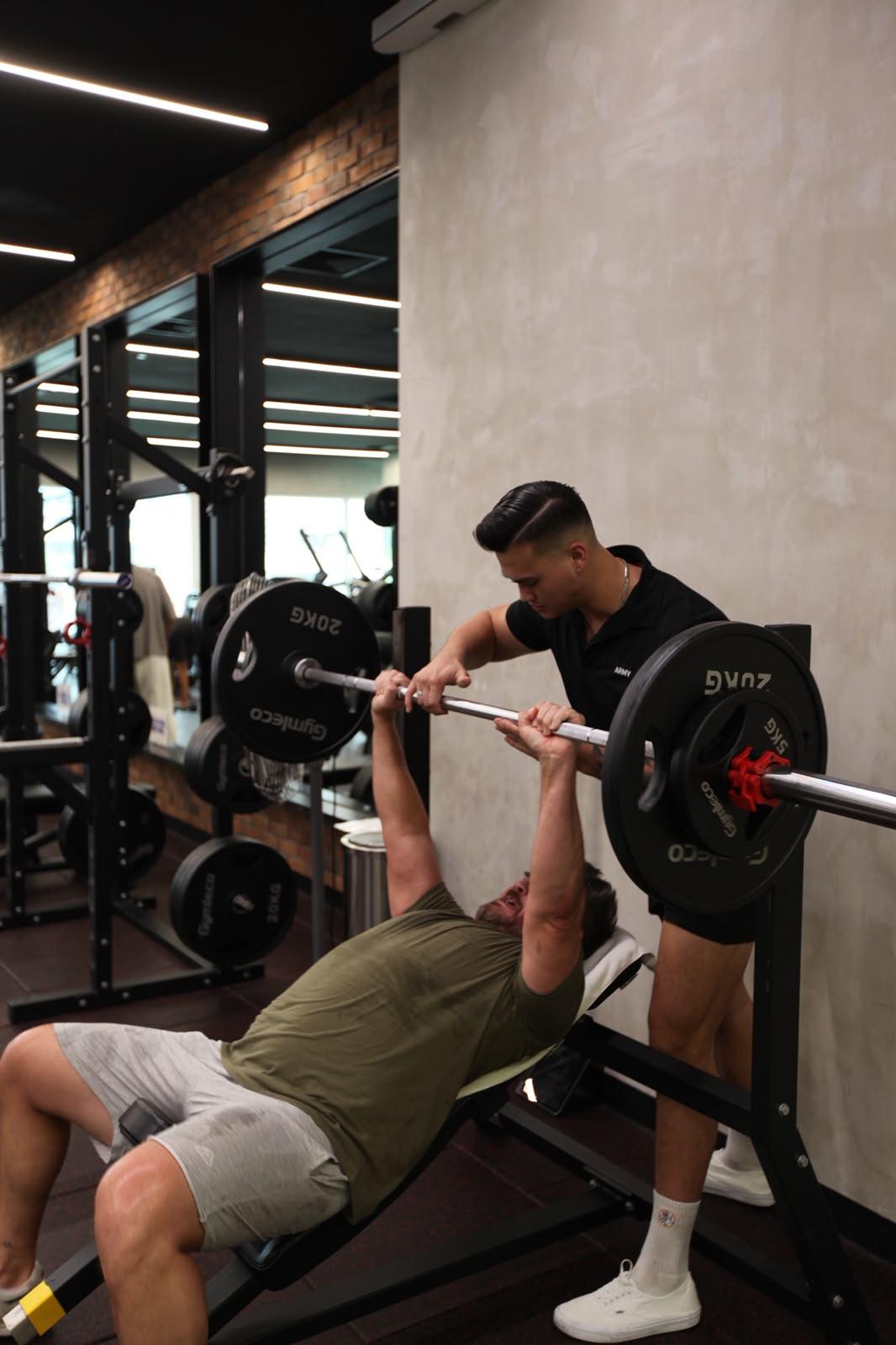
Our coaches at work
Real sessions from our coaches' own galleries. Swipe for more.

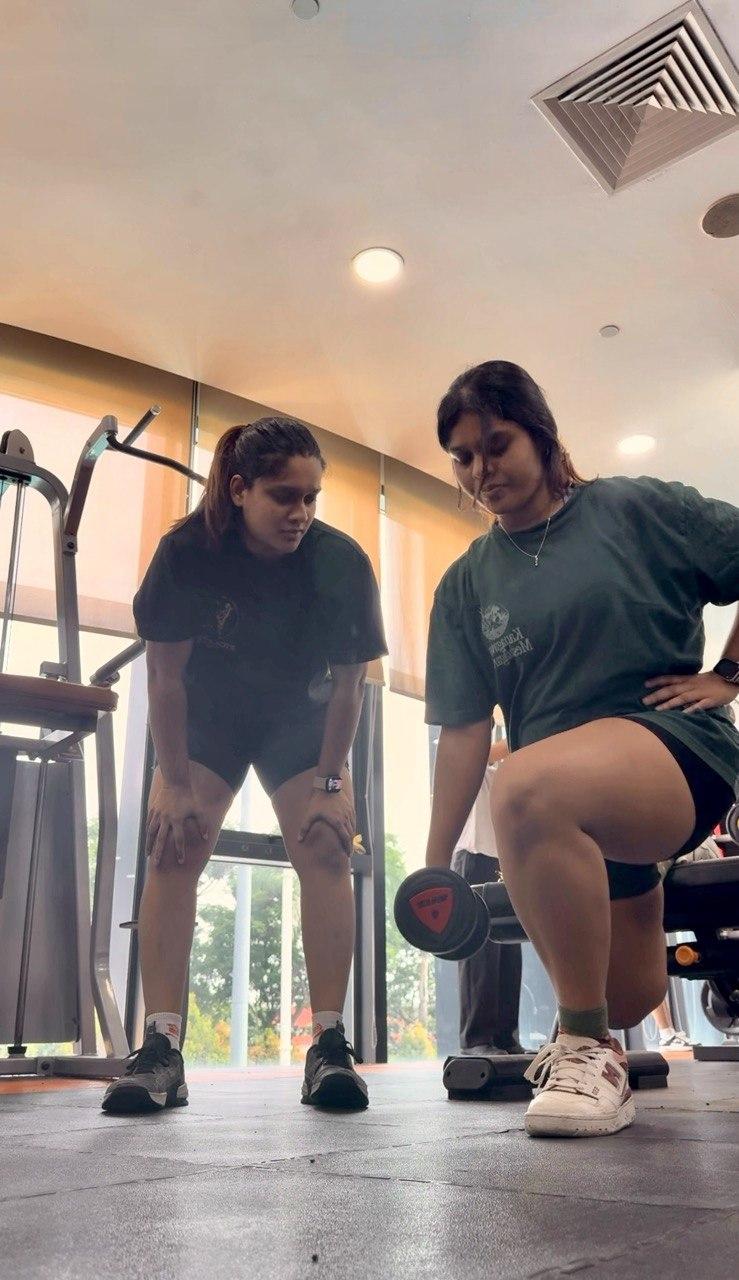
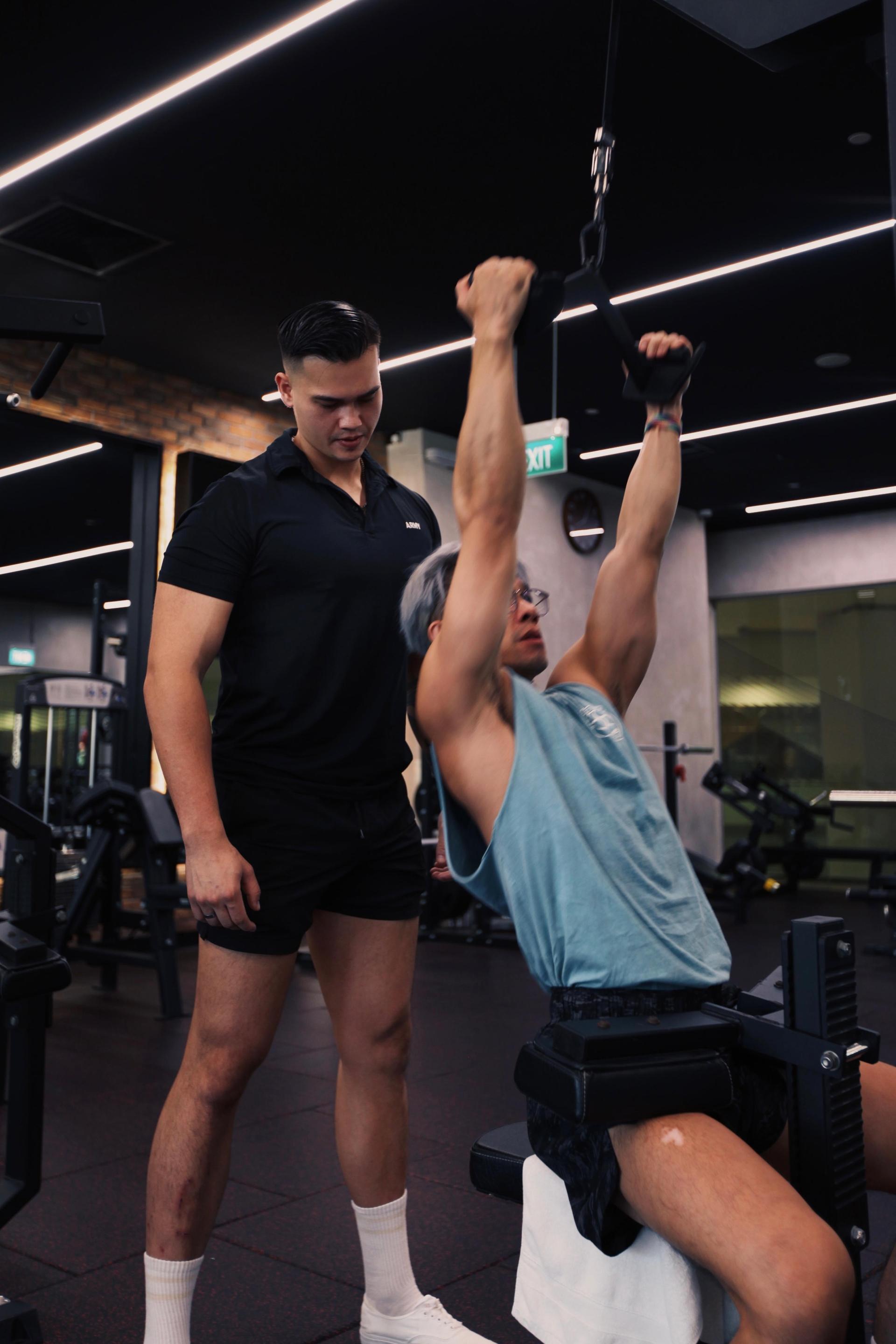
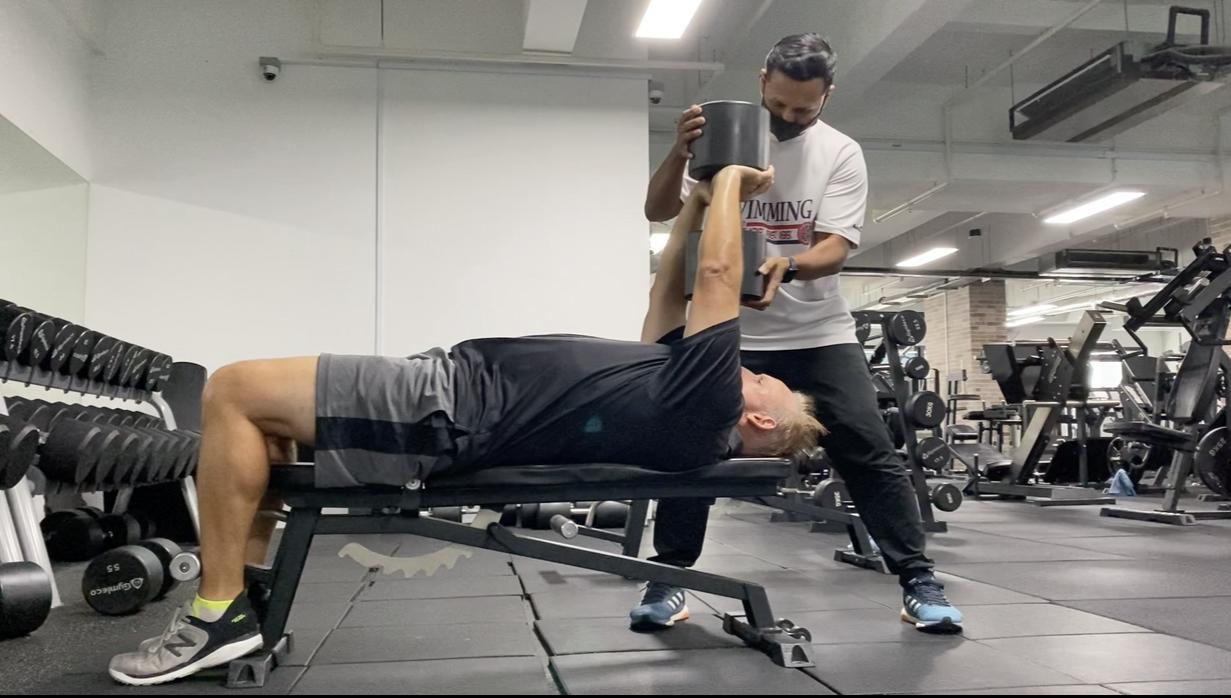
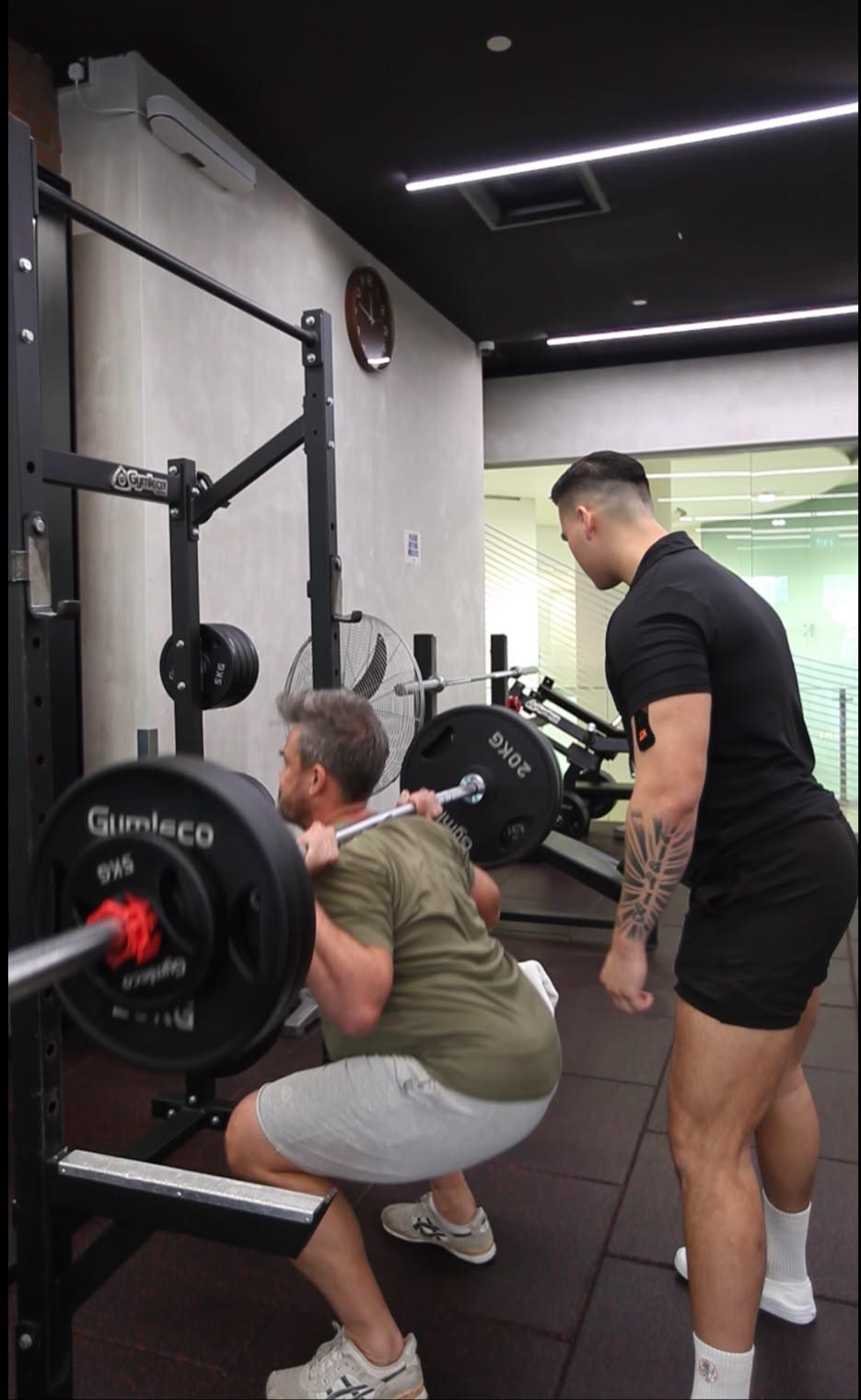
Body fat by age questions.
What is a healthy body fat percentage for a 40-year-old Asian woman?
About 25-35%, using Gallagher et al.'s Asian ranges for ages 40 to 59, which match a BMI of 18.5 to 25. Body fat of 41% or more matches the obesity line of BMI 30. Singapore starts counting risk at a BMI of 23, so the upper end of that range is better treated as a warning zone than a target.
Is the InBody accurate?
It is very repeatable but reads lower than DEXA. One study of 226 adults found an InBody 770 read 3.1 percentage points below DEXA on average, with individual differences up to 8.9 points. Use it to track your own trend under the same conditions, not to compare yourself with a DEXA-based chart.
How much does a DEXA scan cost in Singapore?
On 26 October 2026, providers' own pages listed a DEXA body composition scan at S$120 before GST (Advantage Medical), S$129 including GST (DA MedSuites, which needs a referral or request form outside a health screening), S$207.10 nett (Singapore Women's Clinic) and S$300 before GST (DexaFit Singapore, S$225 on a first visit).
Should I drink water before an InBody test?
Drink normally the day before and hydrate about an hour before, as InBody advises, but do not gulp a lot of water just before stepping on. In one study, drinking 2 litres raised bioimpedance body fat readings by 2.1 to 2.6 points. Test at least 3 hours after a meal and at the same time of day each time.
Is body fat percentage better than BMI?
It measures what BMI only guesses at, which matters in Singapore: a Singapore study found Chinese and Malays at a BMI of about 27 carried the body fat of Caucasians at 30. But a body fat reading is only as good as the machine and the conditions. The HPB-MOH guidelines pair BMI with waist size, which is cheap and repeatable.
Is a DEXA scan safe?
The dose is very low: Advantage Medical puts a whole-body scan under 10 microsieverts, and Singapore Women's Clinic says it is less than a tenth of a chest X-ray. Tell the clinic if you are or might be pregnant.

About this guide
Published
Terms used
- HPB:
- Health Promotion Board, the government agency behind Singapore's public health guidance, including physical activity recommendations and the national effort on diabetes.
Sources
- Healthy percentage body fat ranges: an approach for developing guidelines based on body mass index, Gallagher et al., Am J Clin Nutr 2000;72(3):694-701 (read 26 Oct 2026) · American Journal of Clinical Nutrition
- The paradox of low body mass index and high body fat percentage among Chinese, Malays and Indians in Singapore, Deurenberg-Yap et al., 2000, abstract (read 26 Oct 2026) · International Journal of Obesity
- Health Promotion Board-Ministry of Health Clinical Practice Guidelines: Obesity, Singapore Med J 2016 (read 26 Oct 2026) · Singapore Medical Journal, via PubMed Central
- BMI calculator: Asian BMI bands (read 26 Oct 2026) · Singapore Heart Foundation
- Obesity in Singapore: it's not a small world (read 26 Oct 2026) · HealthHub, Health Promotion Board
- Reliability and agreement of various InBody analyzers compared with DXA, McLester et al., 2020, abstract (read 26 Oct 2026) · Journal of Clinical Densitometry
- Body composition across BMI categories by two multifrequency BIA devices and DXA, Lahav et al., 2021, abstract (read 26 Oct 2026) · European Journal of Clinical Nutrition
- Agreement between 2 segmental bioimpedance devices, BOD POD and DXA in obese adults, Nickerson et al., 2020, abstract (read 26 Oct 2026) · Journal of Clinical Densitometry
- Whole-body DXA demonstrates better reliability than segmental body composition analysis, Kutáč et al., 2019, abstract (read 26 Oct 2026) · PLOS ONE
- The effect of acute hydration on body composition assessed by multi-frequency and single-frequency BIA, Jeong et al., 2023, abstract (read 26 Oct 2026) · Journal of Sports Medicine and Physical Fitness
- Impact of eating and drinking on body composition measurements by bioelectrical impedance, Androutsos et al., 2015, abstract (read 26 Oct 2026) · Journal of Human Nutrition and Dietetics
- Effect of resistance exercise on percent body fat using bioelectrical impedance, Dixon and Andreacci, 2009, abstract (read 26 Oct 2026) · Journal of Strength and Conditioning Research
- The InBody test: testing guidelines (read 26 Oct 2026) · InBody USA
- Body composition assessment (read 26 Oct 2026) · Active Health, ActiveSG Circle
- DEXA body composition scan (read 26 Oct 2026) · Advantage Medical
- BMD total body composition scan (read 26 Oct 2026) · DA MedSuites
- DEXA scan Singapore (read 26 Oct 2026) · Singapore Women's Clinic
- Pricing: DEXA, VO2 max and RMR tests (read 26 Oct 2026) · DexaFit Singapore
- Asian Working Group for Sarcopenia: 2019 consensus update, Chen et al., 2020, abstract (read 26 Oct 2026) · Journal of the American Medical Directors Association
General information, not medical advice.