


After birth8 min read · Updated
Diastasis Recti Exercise After Pregnancy in Singapore
The short answer
Some gap is normal after birth: in a Norwegian study of 300 first-time mothers, 60% had a gap of two finger-widths or more at six weeks and 32.6% at a year, and the NHS says to see your GP if it is still obvious at 8 weeks.
- Gentle deep core work, breathing and walking help, and crunches wait until a physio clears them, not forever.
- Pain, leaking, heaviness or a lump that pushes out need a doctor or women's health physio before any coach.
From S$50 a session. First session 10% off.
Written by the Fit Titans coaching team. Edited by Theon. How we write guides
Diastasis recti is a gap down the middle of your belly after pregnancy.
It is common and usually shrinks. This page covers how to track it at home, which signs mean a physio comes before any trainer, which diastasis recti exercise helps and how a postnatal coach builds load around it. A coach does not diagnose or treat it. This is general information, not medical advice.
On this page (11)
- 1. What is diastasis recti?
- 2. How common is diastasis recti after pregnancy?
- 3. How is diastasis recti checked?
- 4. When should you see a physio or doctor before training?
- 5. What exercises help diastasis recti?
- 6. Do you have to avoid crunches and planks forever?
- 7. What should you avoid in the first weeks after birth?
- 8. Can you run with diastasis recti?
- 9. How does a personal trainer progress training with diastasis recti?
- 10. What should you tell your coach before the first session?
- 11. How do you start with a postnatal coach in Singapore?
Key facts
- Diastasis recti is a separation of the two sides of the six-pack muscle along the midline of the belly (NHS)
- Sperstad et al. 2016: 60% of first-time mothers had a gap of two finger-widths or more at 6 weeks, 45.4% at 6 months and 32.6% at 12 months
- Benjamin et al. 2023 meta-analysis: abdominal exercise narrowed the gap by a small 0.43 cm on average versus usual care
- KKH's principal physiotherapist: avoid crunches or movements that cause a visible bulge along the abdomen
What is diastasis recti?
It is a gap between the two sides of your six-pack muscle, down the middle of your belly. It is also called divarication.
- 01The womb growsThe NHS says your growing womb pushes these muscles apart during pregnancy.
- 02The muscles stretchThey become longer and weaker.
- 03A gap showsOften as a ridge or a soft dip along the midline when you sit up.
A KKH obstetrics consultant, quoted in The Singapore Women's Weekly in July 2026, said it is not medically dangerous in most cases, but a large or lasting gap can affect your quality of life.
How common is diastasis recti after pregnancy?
Very common, and it usually shrinks with time. The best figures we found come from a Norwegian study of 300 first-time mothers (Sperstad and others, British Journal of Sports Medicine, 2016). It counted a gap of two finger-widths or more at, above or below the belly button.
| When | Share with diastasis recti |
|---|---|
| 21 weeks pregnant | 33.1% |
| 6 weeks after birth | 60.0% |
| 6 months after birth | 45.4% |
| 12 months after birth | 32.6% |
These figures are from Norway. We found no published Singapore figure we could verify, so we do not quote one.
How is diastasis recti checked?
By a professional. The Goom, Donnelly and Brockwell guideline says screening should be done by a suitably qualified professional, such as a pelvic health physiotherapist, and your doctor at the postnatal review or a women's health physio confirms it. The NHS also gives a finger-width check you can do at home. Use it to track the gap over weeks, not to diagnose yourself.
- 01Lie on your backBend your knees and keep your feet flat on the floor.
- 02Lift your shouldersRaise your head and shoulders slightly off the floor and look down at your tummy.
- 03Feel the gapWith your fingertips, feel between the edges of the muscles above and below your belly button.
- 04Count fingersSee how many fingers fit in the gap. Repeat every so often to check it is getting smaller.
A home check cannot tell you how well your belly wall works under load. That is what the physio assesses.
When should you see a physio or doctor before training?
See one before a coach if any row below fits you. A coach cannot judge these and should stop the session.
| What you notice | What to do | Source |
|---|---|---|
| The gap is still obvious 8 weeks after birth | Contact your GP or polyclinic. They can refer you to a physio | NHS |
| A bulge along the belly during daily tasks or exercise | See a women's health physio | KKH physiotherapist |
| Getting out of bed or lifting your baby is hard | See a women's health physio | KKH physiotherapist |
| Lower back or pelvic pain that affects daily life | See a women's health physio | KKH physiotherapist |
| Leaking urine during daily activities | See a women's health physio | KKH physiotherapist |
| A lump that gets bigger when you cough and smaller when you lie down | It may be a hernia. See your doctor | NHS |
| A lump with pain, vomiting, a bloated tummy or fever | Get urgent medical help | NHS |
The KKH physiotherapist's list is as reported in The Singapore Women's Weekly. The hernia signs are from the NHS hernia page. Not sure which professional you need? Read physio or personal trainer.
What exercises help diastasis recti?
Gentle deep core work, breathing and good posture, built up slowly. The sources we read agree on that much.
- 01Pelvic floor and deep tummy musclesThe NHS says regular pelvic floor and deep stomach exercises can help reduce the gap.
- 02A simple deep core holdThe NHS describes lying on your side with knees bent, drawing in your lower tummy as you breathe out, holding for a count of 10 while breathing normally, up to 10 times.
- 03Breathing and pelvic tiltsThe Women's Weekly article lists diaphragmatic breathing, the drawing-in manoeuvre and pelvic tilts under KKH's principal physiotherapist.
- 04PostureThe NHS says stand tall and be aware of your posture.
- 05Moderate cardioThe same article lists 150 minutes of moderate aerobic activity a week, such as walking.
| Exercise | How much | Source |
|---|---|---|
| Side-lying deep core hold: draw in your lower tummy as you breathe out | Hold for a count of 10, breathing normally, up to 10 times | NHS |
| Pelvic floor squeezes | As your physio sets, every day | NHS |
| Diaphragmatic breathing, lying or sitting | A few minutes, once or twice a day | KKH physiotherapist |
| Pelvic tilts on your back, knees bent | Slow and controlled, stopping if your midline bulges | KKH physiotherapist |
| Walking | Building toward 150 minutes a week | KKH physiotherapist |
Keep expectations honest. A 2023 meta-analysis (Benjamin and others, Physiotherapy) found abdominal exercise narrowed the gap by only 0.43 cm on average versus usual care. The authors say it may still bring other physical and mental benefits. The aim is a belly wall that copes with load, not a gap of zero. KKH's physiotherapist put it plainly: you do not need to have no gap to be normal.
Do you have to avoid crunches and planks forever?
No, but they wait. Early on, the advice is to avoid them, and later the bulge decides, not a rule.
- Early weeksAvoid themThe NHS says try to avoid sit-ups, planks and high-impact exercise to start with.
- LaterThe bulge ruleKKH's principal physiotherapist says avoid crunches or movements that cause a visible bulge along the abdomen, and keep checking for one during and after exercise.
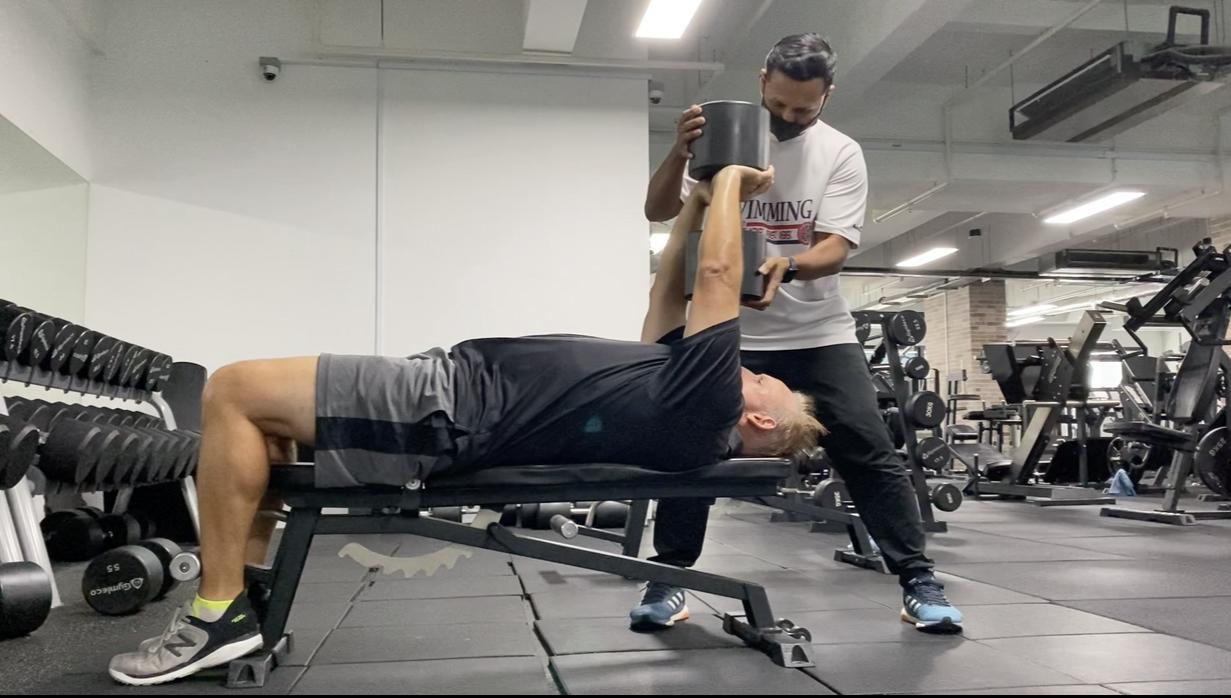
- Physio clearsThey come backA physio tells you when curl-ups and planks can come back, and a coach brings them in at a level where your belly stays flat.
In a 2016 study (Lee and Hodges), a normal curl-up narrowed the gap in women with diastasis but also distorted the midline tissue. A 2026 study of 54 mothers found the same pattern with a crunch. So a narrower gap is not the only goal. How the midline behaves under load matters too.
What should you avoid in the first weeks after birth?
- 01Sit-ups, planks and high-impact exerciseTo start with (NHS).
- 02Heavy lifting and straining on the toilet(NHS).
- 03Anything that makes your midline bulge or dome(KKH physiotherapist).
- 04Heavy lifting without engaging your core, until the gap has reduced or a physio approves (Women's Weekly, KKH physiotherapist).
In the Norwegian study, women who lifted heavy loads 20 or more times a week had higher odds of a gap at 12 months. The authors call this finding uncertain. After a caesarean, read caesarean recovery exercise for what to ask your doctor about lifting.
Can you run with diastasis recti?
Yes, if the gap is functional. The Goom guideline sets out what that looks like during simple tests.
Ready to run
- She can control the pressure inside her belly (Goom guideline)
- She can transfer load across the abdominal wall
Not ready yet
- Doming or sinking at the midline (Goom guideline)
- A sideways shift of the trunk
- Flaring ribs during simple tests
Those tests are a physio's job. The full return plan, not before 12 weeks, is in returning to running after birth.
How does a personal trainer progress training with diastasis recti?
Slowly, inside your physio's advice, and watching your belly every set. A coach does not diagnose the gap or treat it. Their job is to load the rest of you safely. In our practice it runs like this.
- 01Read your physio's notesThe coach starts from what your doctor or physio has cleared, and asks again if anything is unclear.
- 02Breathing and deep core firstBreathing, pelvic floor work and the deep core holds above, done in every session.
- 03Daily movementsSquats, hinges, rows and carries at light loads, the moves you use to lift your baby and the stroller.
- 04Watch the midlineIf your belly domes or bulges, the coach lowers the load or changes the angle on the spot.
- 05Add load, then harder core workHeavier weights first, then curl-up and plank variations once your physio agrees and your belly stays flat.
- 06Refer backPain, leaking, heaviness or a new lump ends the exercise, and you go back to your physio.
For the bigger picture of postnatal training, when it starts and a 12-week plan, read postnatal personal trainer in Singapore.
What should you tell your coach before the first session?
- 01How many weeks since birth, and whether it was a vaginal birth or a caesarean.
- 02What your doctor said at your postnatal review, and any physio findings on the gap.
- 03Your finger-width count over time, if you have been tracking it.
- 04Any symptomsBack or pelvic pain, leaking, heaviness or a bulge.
- 05What you lift every dayYour baby, a car seat, the stroller, shopping.
- 06Whether you are breastfeeding, and how you are sleeping.
How do you start with a postnatal coach in Singapore?
Tell us your weeks since birth and what your physio said, and we match you with a coach who lists postnatal training. Coaches come to your home, your condo gym, a park or a gym that allows outside trainers.
- 01First sessionA paid trial at 10% off your coach's rate.
- 02After thatPacks of 5, 10, 15 or 20 sessions. Each coach sets their own rate, shown on the pricing page.
- 03A woman coachAsk and we only match you with women. See female personal trainer.
- 04Still pregnantStart with prenatal personal training.
Ready when your doctor or physio has cleared you? Get matched and mention the gap in your first message.
Questions about diastasis recti
Does diastasis recti go away on its own?
Often, yes. The NHS says it usually returns to normal by the time your baby is 8 weeks old, and in the Norwegian study the share with a gap fell by almost half between 6 weeks and 12 months.
Can a personal trainer diagnose or fix diastasis recti?
No. A doctor or women's health physio confirms it and guides its rehab. A postnatal coach works inside that advice, builds strength around it and stops any exercise that makes your midline bulge.
Does diastasis recti cause back pain?
Not always. In the Norwegian study, lower back and pelvic pain at 12 months was not significantly different between women with and without a gap, though most gaps there were mild. If back or pelvic pain affects daily life, see a women's health physio.
Can I do crunches with diastasis recti?
Not in the early weeks. Later, a physio decides when curl-ups come back, and the test is simple: your midline stays flat during and after the set.
Can I ask for a female coach for postnatal training?
Yes. Say so when you message us and we only match you with women. See our female personal trainer page.

About this guide
Published
Sources (8) and terms used
Terms used
- Diastasis recti:
- A separation of the two sides of the rectus abdominis along the midline, common late in pregnancy and after birth.
- Pelvic floor:
- The muscles across the base of the pelvis that support the bladder, bowel and uterus.
Sources
- Your post-pregnancy body: separated stomach muscles (checked 7 Nov 2026) · NHS
- Hernia: symptoms and when to get help (checked 7 Nov 2026) · NHS
- Sperstad JB et al. Diastasis recti abdominis during pregnancy and 12 months after childbirth: prevalence, risk factors and report of lumbopelvic pain. Br J Sports Med 2016, 50(17), pages 1092 to 1096 (checked 7 Nov 2026) · British Journal of Sports Medicine, via PubMed Central
- Benjamin DR et al. Conservative interventions may have little effect on reducing diastasis of the rectus abdominis in postnatal women: a systematic review and meta-analysis. Physiotherapy 2023, 119, pages 54 to 71 (checked 7 Nov 2026) · Physiotherapy, via PubMed
- Lee D, Hodges PW. Behavior of the linea alba during a curl-up task in diastasis rectus abdominis: an observational study. JOSPT 2016, 46(7), pages 580 to 589 (checked 7 Nov 2026) · Journal of Orthopaedic and Sports Physical Therapy, via PubMed
- Rejano-Campo M et al. Immediate effect of four exercises on linea alba thickness, distortion and inter-recti distance in parous women. Physiother Res Int 2026, 31(2), e70185 (checked 7 Nov 2026) · Physiotherapy Research International, via PubMed
- Goom T, Donnelly G, Brockwell E. Returning to running postnatal: guidelines for medical, health and fitness professionals, 2019 (checked 7 Nov 2026) · Goom, Donnelly and Brockwell
- Diastasis recti after pregnancy, quoting a KKH obstetrics consultant and KKH's principal physiotherapist, 11 July 2026 (checked 7 Nov 2026) · The Singapore Women's Weekly
General information, not medical advice.