


Desk neck9 min read · Updated
Office Syndrome in Singapore: Neck Pain Exercises for Desk Workers
The short answer
Office syndrome is an everyday name.
- Singapore General Hospital calls it occupational overuse syndrome.
- It describes neck, shoulder and upper-back aches from desk work.
- Reviews of trials in office workers found that strengthening the neck, shoulder and shoulder-blade muscles reduced neck pain, with low-certainty evidence, and that exercise probably cuts the risk of a new episode.
- Break from sitting every 30 minutes, set your screen at eye level, and see a doctor first for arm weakness, numbness, pain after a fall or dizziness.
From S$50 a session. First session 10% off.
Written by the Fit Titans coaching team. Edited by Theon. How we write guides
Office syndrome is the everyday name for the stiff neck, tight shoulders and rounded upper back that come with long desk days.
This page covers the symptoms, the warning signs that mean a doctor or physio first, what the evidence says helps, a desk routine, a strength routine and how a coach fits in. It is general information, not medical advice.
On this page (12)
- 1. What is office syndrome?
- 2. How common is neck pain among office workers in Singapore?
- 3. When should you see a doctor or physio first?
- 4. What does the evidence say helps office neck pain?
- 5. How should you set up your desk to ease neck strain?
- 6. How often should you take a break from sitting?
- 7. What is a simple desk routine for neck and shoulders?
- 8. What strength exercises help a stiff neck and upper back?
- 9. How does a coach train office syndrome at home or in a condo gym?
- 10. When is it a physio's job instead of a coach's?
- 11. Is this the same as back pain or shoulder injury training?
- 12. How do you start with a Fit Titans coach for office syndrome?
Key facts
- In an SGH survey of 324 office workers, 73% had pain in at least one body part, most often the neck (46%), shoulder (42%) and low back (42%)
- A 2024 review of 8 trials found low-certainty evidence that strengthening the neck, shoulder and scapular muscles reduces neck pain in office workers (Jones et al.)
- Exercise roughly halved the odds of a new episode of neck pain over 12 months in a 2023 review of 5 trials, most participants office workers (Teichert et al.)
- The WSH Council lists work-related musculoskeletal disorders among the top three occupational diseases in Singapore
What is office syndrome?
Office syndrome is an everyday name rather than the term doctors use. Singapore General Hospital groups these problems as occupational overuse syndrome, discomfort or persistent pain in muscles, tendons and other soft tissues when a job's physical demands outpace the body. Its examples are stiff necks and shoulders, backaches and end-of-day shoulder and back pain.
- 01Neck stiffnessThat builds through the working day.
- 02Tight, aching shouldersAnd a rounded upper back.
- 03Lower back acheFrom long sitting, covered on our back pain page.
- 04A nagging pain in the hands, which SGH also lists.
The NHS names poor posture, such as sitting at a desk for long periods, as a common cause of neck pain, and says most neck pain only lasts a few weeks.
How common is neck pain among office workers in Singapore?
Very common. In an SGH survey reported on SingHealth, nearly three in four office workers had pain somewhere, and the neck led the list.
SGH linked it to raised shoulders, too much bending and twisting of the neck and back, and sitting on the front edge of the chair with the back unsupported. The WSH Council counts work-related musculoskeletal disorders among the top three occupational diseases in Singapore.
When should you see a doctor or physio first?
See a doctor before you train if any sign below applies. These are from NHS physiotherapy pages by Dynamic Health and Musculoskeletal Matters, Dorset. A coach does not judge these signs.
Urgent help, today
- Neck pain that started suddenly after a fall or other trauma (Dynamic Health)
- Arms or legs getting weaker or clumsier (Dynamic Health)
- Worsening balance when walking (Dynamic Health)
- New bladder or bowel changes (Dynamic Health)
- In Singapore, call 995 in an emergency
See a doctor before you train
- Arm or hand symptoms: pain, tingling, numbness or weakness in the arms, or trouble with buttons and jars (Dynamic Health, Dorset)
- Dizziness and more: dizziness, blackouts, double vision, slurred speech or swallowing problems after the neck pain began (Dynamic Health)
- Night pain: pain at night that stops you sleeping or lying flat (Dorset)
- Feeling unwell: fever, night sweats or weight loss (Dorset)
- Stiffness in both shoulders: sudden stiffness in the neck and both shoulders (Dynamic Health)
- No change: pain or stiffness that does not go away after a few weeks, or painkillers that have not worked (NHS)
What does the evidence say helps office neck pain?
Strengthening exercise has the best support, and workstation changes help too. The trials are small and often at high risk of bias, so treat the size of the effect with care.
| Review | What it found | Certainty |
|---|---|---|
| Jones, Jadhakhan and Falla, 2024 | Strengthening the neck, shoulder and scapular muscles reduced neck pain and disability in 8 trials | Low |
| Louw et al., 2017 | A clinically meaningful drop in pain with strengthening against no exercise. Stretching and endurance work need more study | Level II evidence |
| Teichert et al., 2023 | Exercise probably reduced the risk of a new episode of neck pain over 12 months (odds ratio 0.49) in 5 trials, 80% of participants office workers | Moderate |
| Frutiger and Borotkanics, 2021 | Neck strengthening and tailored workstation changes reduced neck pain across 29 trials | Low |
How should you set up your desk to ease neck strain?
Screen at eye level, feet flat and elbows at about 90 degrees. This is SGH's office ergonomics guidance.
| Part | What SGH advises |
|---|---|
| Chair | Feet flat on the floor, thighs about level, lower legs about upright. A footrest if needed. Backrest supporting the lower back curve |
| Desk | Top just below elbow height, shoulders relaxed, elbows bent to about 90 degrees |
| Monitor | Top of the screen level with or slightly below eye level, about an arm's length away, straight in front |
| Keyboard and mouse | Keyboard flat, wrists not bent, mouse beside the keyboard. Let go of the mouse when not using it |
On a laptop the screen sits far below eye level. A laptop stand with a separate keyboard and mouse brings it up to the height SGH describes.
How often should you take a break from sitting?
Every 30 minutes, says SGH, and a 5 to 10 minute break relieves strain and tension. The NHS says not to keep your neck in the same position for a long time, and Dynamic Health advises changing position regularly and adding general exercise you enjoy, such as walking or swimming.
- WorkSit for up to 30 minutes, the gap SGH advises between breaks.
- ReminderA 30-minute reminder on your phone or watch until the habit sticks.
- BreakStand for calls, walk to a colleague instead of messaging, or refill your water bottle at a far pantry.
What is a simple desk routine for neck and shoulders?
Five minutes of the stretches SGH lists, done slowly. Hold each for 10 to 30 seconds, breathe normally and do not bounce. SGH says to check with your doctor or therapist first if a medical condition limits these movements, and to stop and see a therapist if they hurt.
- 01Shoulder rollsRoll both shoulders up, back and down, slowly, several times.
- 02Seated neck stretchSit tall, hold the side of the chair with one hand and tilt your head gently away. Swap sides.
- 03Doorway stretchForearms on a door frame at elbow height, step through until you feel the front of the chest. Repeat at ear height and overhead.
- 04Overhead reachInterlace your fingers and push your palms to the ceiling, then lean gently to each side.
- 05Hands behind the backInterlace your fingers behind you and lift your hands a little to open the chest.
What strength exercises help a stiff neck and upper back?
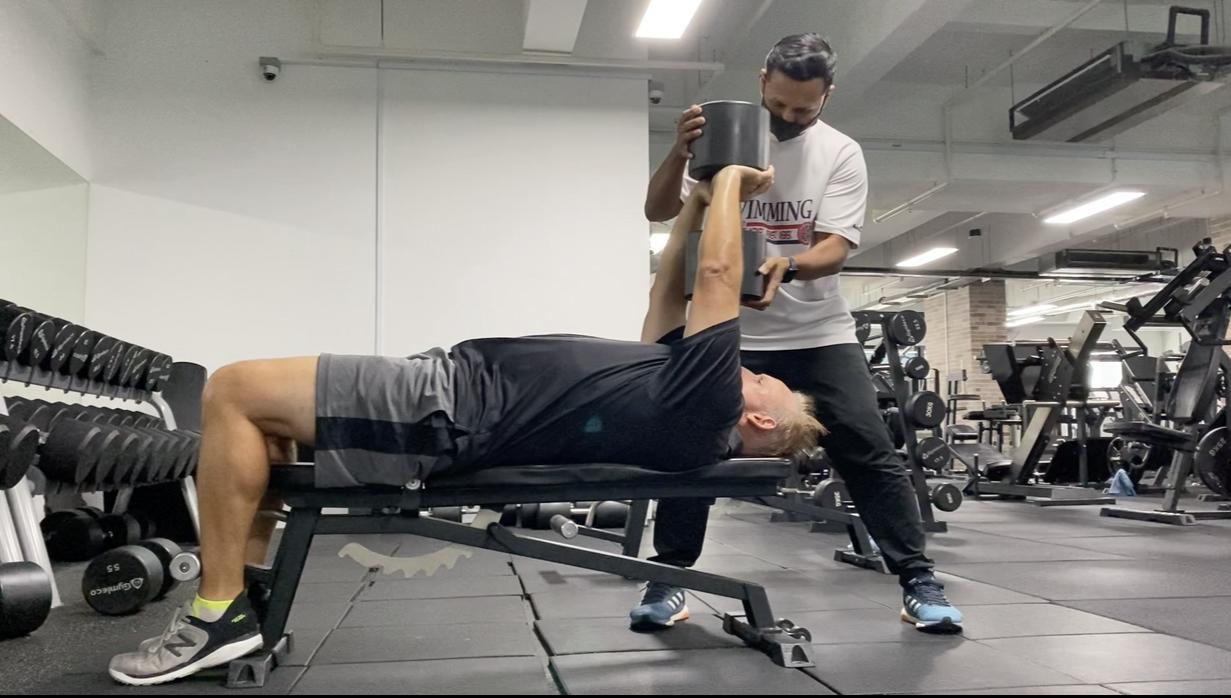
Exercises that work the upper back, the muscles around the shoulder blades and the neck, which is what the reviews tested. The plan below is coaching advice for people with no injury diagnosis, not treatment. Two or three days a week, with a rest day between, suits most beginners.
| Exercise | Sets and reps | What to feel |
|---|---|---|
| Band row | 2 to 3 sets of 12 | Shoulder blades drawing back, neck relaxed |
| Band pull-apart | 2 to 3 sets of 15 | Upper back working, shoulders staying down |
| Chin tuck, lying or against a wall | 2 sets of 8, 5-second hold | Gentle work at the front of the neck, no strain |
| Prone Y raise | 2 sets of 8 to 10 | Lower shoulder blades lifting the arms |
| Face pull with a band | 2 sets of 12 | Back of the shoulders and upper back |
How much discomfort is fine? Dynamic Health says pain up to 4 out of 10 during exercise is acceptable if it settles within 45 minutes and does not affect your sleep or the next day. If it goes higher, make the exercise easier. Expect 6 to 12 weeks for a good improvement, by the same source.
How does a coach train office syndrome at home or in a condo gym?
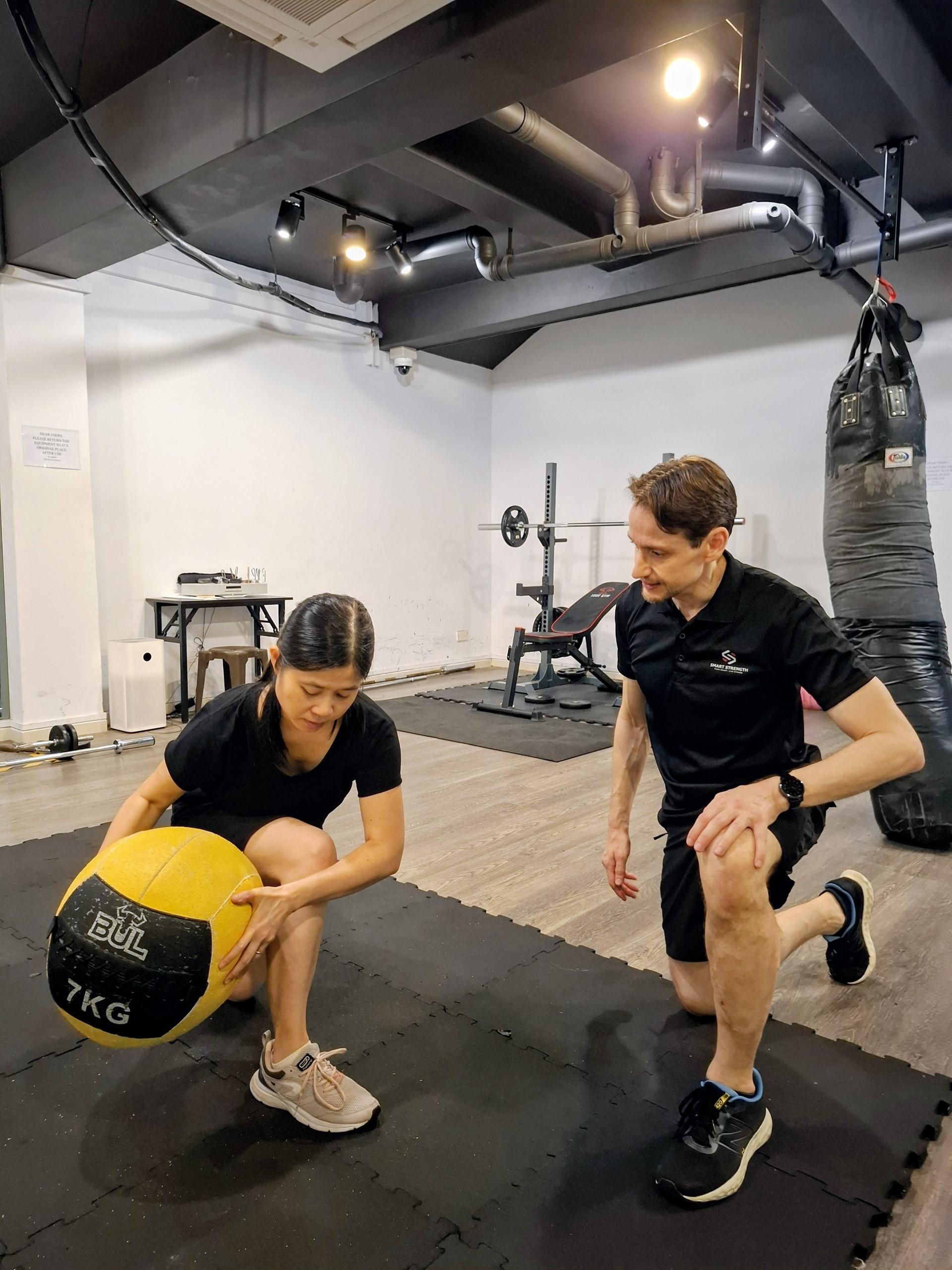
A coach builds upper-back strength and better movement habits around your working week. A band, a pair of dumbbells and a mat cover most of it, so a living room or condo gym works.
- 01Check the red flagsBefore the first session, the coach asks about the warning signs above. Any yes means a doctor first.
- 02Watch how you sit and moveA look at your desk set-up and how you reach, lift and turn your head, so the plan fits your day.
- 03Build the upper backRows, pull-aparts and raises, loaded a little more each week once the form is steady.
- 04Train the whole bodySquats, hinges, carries and some cardio, since general exercise is part of the advice for neck pain.
- 05Keep a desk planA short routine for between sessions, and a log of how the neck felt the next day.
If you live in a flat with little space, see the HDB living room workout. For lunchtime or after-work slots near the office, see personal trainer CBD.
When is it a physio's job instead of a coach's?
When there is pain that needs assessing, not only stiffness. A coach does not diagnose or treat.
A coach's job
- Desk-related neck, shoulder and upper-back stiffness with no diagnosis
- Upper-back strength and general fitness, with no red flags
See a doctor or physio when
- Any red flag from the list above applies
- Symptoms have not started to improve after 6 weeks, when Dynamic Health advises an earlier assessment
- The stretches or exercises hurt, or pain and tension persist daily, which SGH says may mean a muscle, joint or nerve problem
- Pain runs down the arm or comes with tingling
Once a physio has assessed you, a coach can work to their plan. Who to see first is set out in physio or personal trainer.
Is this the same as back pain or shoulder injury training?
No. This page is desk-related neck, shoulder and upper-back stiffness with no diagnosis. Two other guides cover the rest.
- Lower back pain: the order to rebuild in and when to see a doctor are on training with back pain.
- A diagnosed shoulder injury: rehab phases, what to avoid and how pressing comes back are on shoulder injury training.
How do you start with a Fit Titans coach for office syndrome?
Message us with your goal, your working hours and where you would like to train. A coach comes to your home, your condo gym, a park or a gym that allows outside trainers, and some coach online by video.
A 60-minute session with our coaches starts from S$50 (measured October 2026). The first session is a paid trial at 10% off the coach's rate. After it, sessions come in packs of 5, 10, 15 or 20, paid by PayNow. Home sessions are explained on home personal training.
Read next
If long sitting leaves your hips stiff as well, see hip pain exercises for hourly movement and a gentle routine.
For the hips, hamstrings and calves as well as the neck, follow our 10-minute daily stretching routine.
Questions about office syndrome
Is office syndrome a real medical condition?
It is an everyday name. SGH describes the same group of problems as occupational overuse syndrome or work-related musculoskeletal disorders, such as stiff necks and shoulders and backaches from desk work.
What are the best neck pain exercises for desk workers?
Reviews of trials in office workers found the best support for strengthening the neck, shoulder and shoulder-blade muscles, with low-certainty evidence. Rows, band pull-aparts and chin tucks are common coaching choices. See a doctor first if you have arm numbness, weakness or pain after a fall.
How often should I take a break from my desk?
SGH advises a break from sitting every 30 minutes, and says a 5 to 10 minute break relieves strain and tension. The NHS says not to keep your neck in the same position for a long time.
How long does office neck pain take to go away?
The NHS says most neck pain only lasts a few weeks. Dynamic Health, an NHS physiotherapy service, says to expect 6 to 12 weeks of exercise for a good improvement, and to get assessed earlier if nothing has improved after 6 weeks.
Can a personal trainer fix office syndrome?
A coach does not diagnose or treat. A coach can build upper-back strength and general fitness for people with no red flags and no diagnosis. Pain that needs assessing, or any warning sign, goes to a doctor or physio first.

About this guide
Published
Sources (10) and terms used
Terms used
- Condo gym:
- The shared gym in a private condominium, run by the building's management.
Sources
- Neck pain (checked 8 Nov 2026) · NHS
- Neck pain (checked 8 Nov 2026) · Dynamic Health, East of England Community Health and Care NHS Trust
- Neck pain (checked 8 Nov 2026) · Musculoskeletal Matters, NHS Dorset
- Office ergonomics and occupational overuse syndrome (checked 8 Nov 2026) · Singapore General Hospital (SingHealth)
- Musculoskeletal disorders and office ergonomics (checked 8 Nov 2026) · Singapore General Hospital (SingHealth)
- About workplace ergonomics (checked 8 Nov 2026) · Workplace Safety and Health Council
- Jones, Jadhakhan and Falla. The influence of exercise on pain, disability and quality of life in office workers with chronic neck pain. Applied Ergonomics 2024, 117:104216 (checked 8 Nov 2026) · PubMed, National Library of Medicine
- Louw et al. Effectiveness of exercise in office workers with neck pain. S Afr J Physiother 2017, 73(1):392 (checked 8 Nov 2026) · PubMed, National Library of Medicine
- Teichert et al. Effectiveness of exercise interventions for preventing neck pain. JOSPT 2023, 53(10):594 (checked 8 Nov 2026) · PubMed, National Library of Medicine
- Frutiger and Borotkanics. Strength training and workplace modifications may reduce neck pain in office workers. Pain Practice 2021, 21(1):100 (checked 8 Nov 2026) · PubMed, National Library of Medicine
General information, not medical advice.