


Hip pain8 min read · Updated
Hip Pain Exercises in Singapore
The short answer
Two common causes of hip pain in adults are osteoarthritis, felt in the groin, and trouble with the tendons on the outer hip, called gluteal tendinopathy.
- Exercise is a strongly recommended treatment for hip osteoarthritis, and an education plus exercise programme beat a steroid injection for gluteal tendinopathy in the LEAP trial.
- Go to A&E for severe pain after a fall or if you cannot put weight on the leg.
- Your doctor or physio's plan comes first, and a coach works inside it.
From S$50 a session. First session 10% off.
Written by the Fit Titans coaching team. Edited by Theon. How we write guides
Hip pain exercises help most when you know which kind of hip pain you have.
This page covers the common causes in adults, the warning signs that mean a doctor first, what the evidence supports, the positions to change and how a coach trains around a sore hip at home or in a condo gym. It is general information, not medical advice.
On this page (10)
- 1. What usually causes hip pain in adults?
- 2. When is hip pain an emergency?
- 3. Does exercise help hip osteoarthritis?
- 4. What helps pain on the outer hip?
- 5. Which positions should you change with hip pain?
- 6. What if your hip feels stiff after long sitting?
- 7. What do hip pain exercises look like in a session?
- 8. How does a coach train around hip pain at home or in a condo gym?
- 9. Is it different if you are older or have weak bones?
- 10. How do you start with a Fit Titans coach for hip pain?
Key facts
- Dynamic Health, an NHS physiotherapy service, says the hip is one of the joints most often affected by osteoarthritis, especially over age 50
- Land-based exercise reduced pain and improved function in hip osteoarthritis across 9 trials and 549 people, with benefits lasting 3 to 6 months (Cochrane, 2014)
- The 2019 ACR guideline strongly recommends exercise, and weight loss for those who are overweight, for hip and knee osteoarthritis
- In the LEAP trial of 204 adults, education plus exercise gave more global improvement than a steroid injection at 8 and 52 weeks (BMJ, 2018)
What usually causes hip pain in adults?
Osteoarthritis and outer hip tendon pain are two common causes. Dynamic Health says the hip is one of the joints most often affected by osteoarthritis, especially over 50, and that low back problems can also send pain into the hip.
| Cause | Where it hurts | Typical pattern |
|---|---|---|
| Hip osteoarthritis | Deep in the front of the groin, sometimes the thigh, buttock or down to the knee | Morning stiffness that eases with activity. The NHS links it to age over 45 and pain worse when walking |
| Gluteal tendinopathy | The outer hip, sometimes down the outer thigh | Lying on that side, standing on one leg, low chairs, rising from a chair, hills and stairs |
| Sprain, strain or tendonitis | Around the hip | Pain, swelling or bruising after intense or repetitive exercise |
| Bursitis | The side of the hip, spreading to the thigh | Worse when moving or lying on your side |
Gluteal tendinopathy is now the preferred name for what was often called trochanteric bursitis, says Cambridge University Hospitals, because the tendons are the main source of the pain. It is about four times more common in women, especially around and after menopause.
When is hip pain an emergency?
When it follows a fall, or you cannot put weight on the leg. These signs come from the NHS hip pain page. In Singapore, call 995 in an emergency. A coach does not judge these signs.
- NowGo to A&E nowSevere hip pain after a fall or injury, you cannot walk or put weight on the leg, or tingling or loss of feeling in the hip or leg after an injury.
- UrgentSee a doctor urgentlySevere pain that started suddenly with no fall, a hip that is swollen and hot, skin around the hip changing colour, or hip pain with a high temperature or feeling unwell.
- SoonSee a doctor soonPain that stops normal activities or sleep, keeps getting worse or keeps coming back, has not improved after 2 weeks of home care, or stiffness lasting more than 30 minutes after waking.
- AlsoAlso on CGH's listConstant hip pain, pain that wakes you at night, or pain with fever, weight loss or loss of appetite.
Does exercise help hip osteoarthritis?
Yes. Exercise is a first-line treatment with strong support. The NHS says regular exercise that builds muscle and strengthens the joints usually helps, and warns that too much too quickly, or the wrong sort, may hurt the joint.
| Source | What it says |
|---|---|
| Fransen et al., Cochrane 2014 | Land-based exercise cut pain and improved function in 9 trials of 549 people, high-quality evidence. Five trials found the benefit lasted 3 to 6 months |
| ACR and Arthritis Foundation guideline, 2019 | Strongly recommends exercise, weight loss if overweight, self-management programmes, tai chi and a cane for hip and knee osteoarthritis |
| Changi General Hospital | An exercise programme, often through a physio, for range of motion, stretching and strength, plus weight management advice |
| NHS | A mix of muscle strengthening and general fitness, to a plan from your GP or physio |
CGH advises avoiding high-impact activity such as running and jumping, and choosing swimming, walking and cycling for cardio fitness. The 2014 review found no significant difference in drop-out between exercise and no exercise.
What helps pain on the outer hip?
Load management advice plus progressive strengthening. In the LEAP trial, 204 adults aged 35 to 70 with gluteal tendinopathy confirmed by MRI got education plus exercise over 8 weeks, a steroid injection, or wait and see.
The Royal National Orthopaedic Hospital calls physiotherapy the first-line treatment, in two parts: changing daily positions that squash the tendon, and a tailored programme to build strength and control around the hip. CUH starts with static holds to ease pain, then builds to bridges and sit-to-stands, and strengthens both hips.
Which positions should you change with hip pain?
Low chairs for both conditions, and anything that squashes the outer hip for tendon pain. These changes come from NHS hospital leaflets.
| Situation | What to change | Source |
|---|---|---|
| Sitting | Avoid low chairs. For outer hip pain, keep your hips higher than your knees, a wedge cushion may help, and do not cross your legs | NHS, CUH, RNOH |
| Sleeping | Do not lie on the sore hip. Put a pillow between your knees, try lying halfway between front and side, or lie on your back with pillows under your knees if both hips hurt | CUH, RNOH |
| Standing | Keep weight even on both feet and do not hang on one hip, such as holding a child on one side | CUH |
| Stairs | Use a rail and keep the knee in line over the hip | CUH, RNOH |
| Stretching | For outer hip pain, avoid buttock and ITB stretches and long end-range hip stretches | CUH |
| Long sitting | Do not stay still for long. Move the hip gently for 10 to 20 seconds every hour | Dynamic Health |
One exercise, two answers. Clams and side-lying leg lifts appear in osteoarthritis exercise lists from CGH and the Royal Orthopaedic Hospital, but CUH lists them as aggravating for gluteal tendinopathy. This is why the diagnosis and the physio's plan decide the exercises, not a general list.
What if your hip feels stiff after long sitting?
Get up and move it often, and add a gentle stretch. Dynamic Health advises moving the hip every hour, and the NHS suggests gentle hip stretching. Stiffness after waking that lasts over 30 minutes, or pain that keeps returning, is a reason to see a doctor.
- 01Stand up every hourWalk to the pantry or stand for a call. Move the hip for at least 10 to 20 seconds.
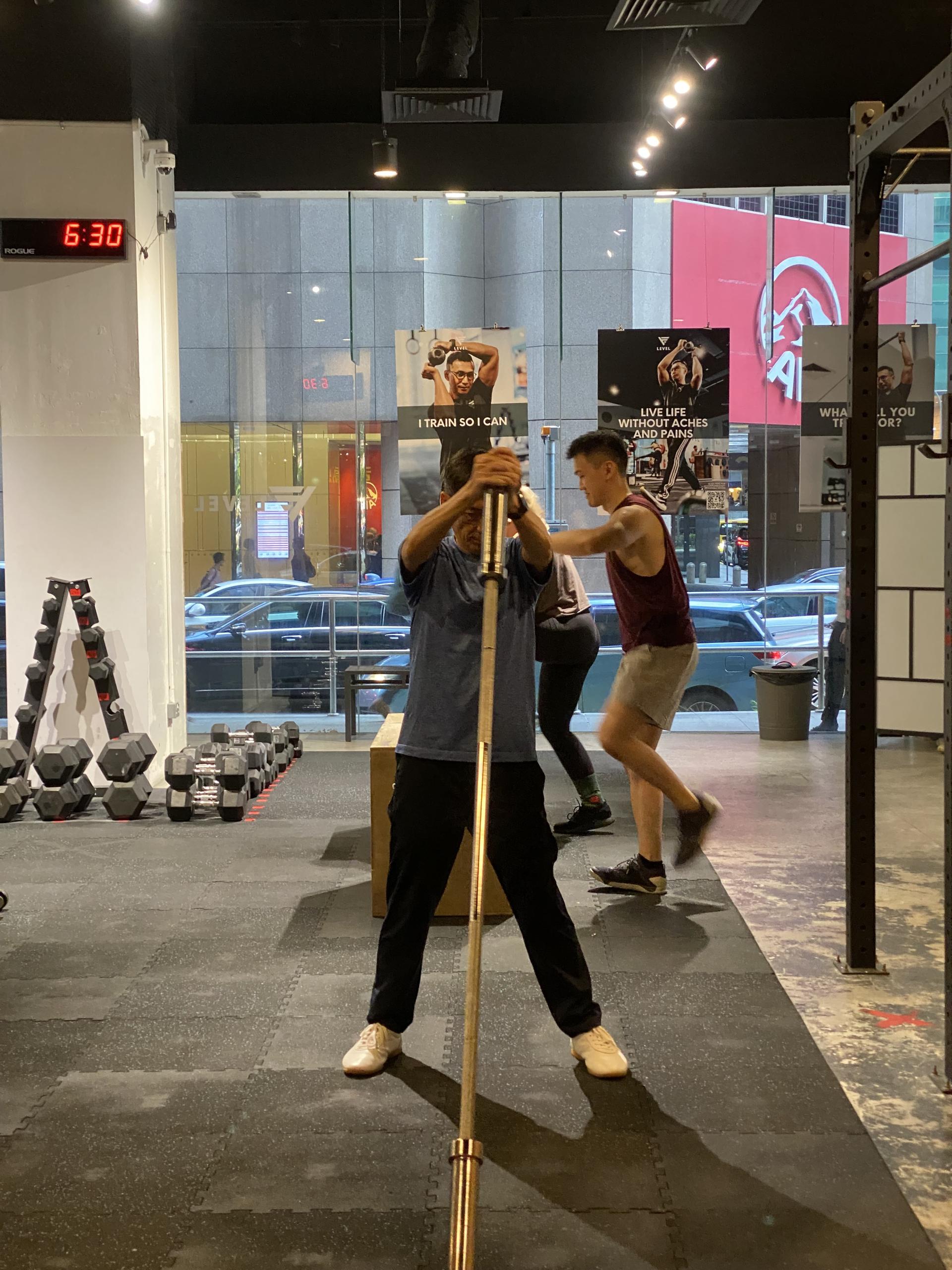
- 02Hip flexor stretchWide walking stance, hands on a firm support, front knee bent. Push the hips forward with a straight back. Hold 20 to 30 seconds, 5 times, as in the Royal Orthopaedic Hospital sheet.
- 03BridgeLie on your back, knees bent. Squeeze the buttocks and lift without arching your back. Repeat 10 times.
Desk-related neck and back stiffness is covered on office syndrome exercises, and lower back pain on training with back pain.
What do hip pain exercises look like in a session?
Strength for the hip and thigh, done slowly and within a pain limit. The table is coaching advice for people already assessed or with mild ongoing symptoms, built from exercises in NHS and CGH sheets. It is not a medical prescription, and your physio's plan replaces it.
| Exercise | Sets and reps | Notes |
|---|---|---|
| Static glute squeeze, lying | 10 holds of 10 seconds | A gentle start for a sore day |
| Bridge | 2 to 3 sets of 10 | Progress to a single-leg bridge |
| Sit-to-stand from a high chair | 2 to 3 sets of 8 | Lower the seat only as it stays comfortable |
| Mini squat holding a support | 2 sets of 10 | No deeper than about 45 degrees at first, as in the ROH sheet |
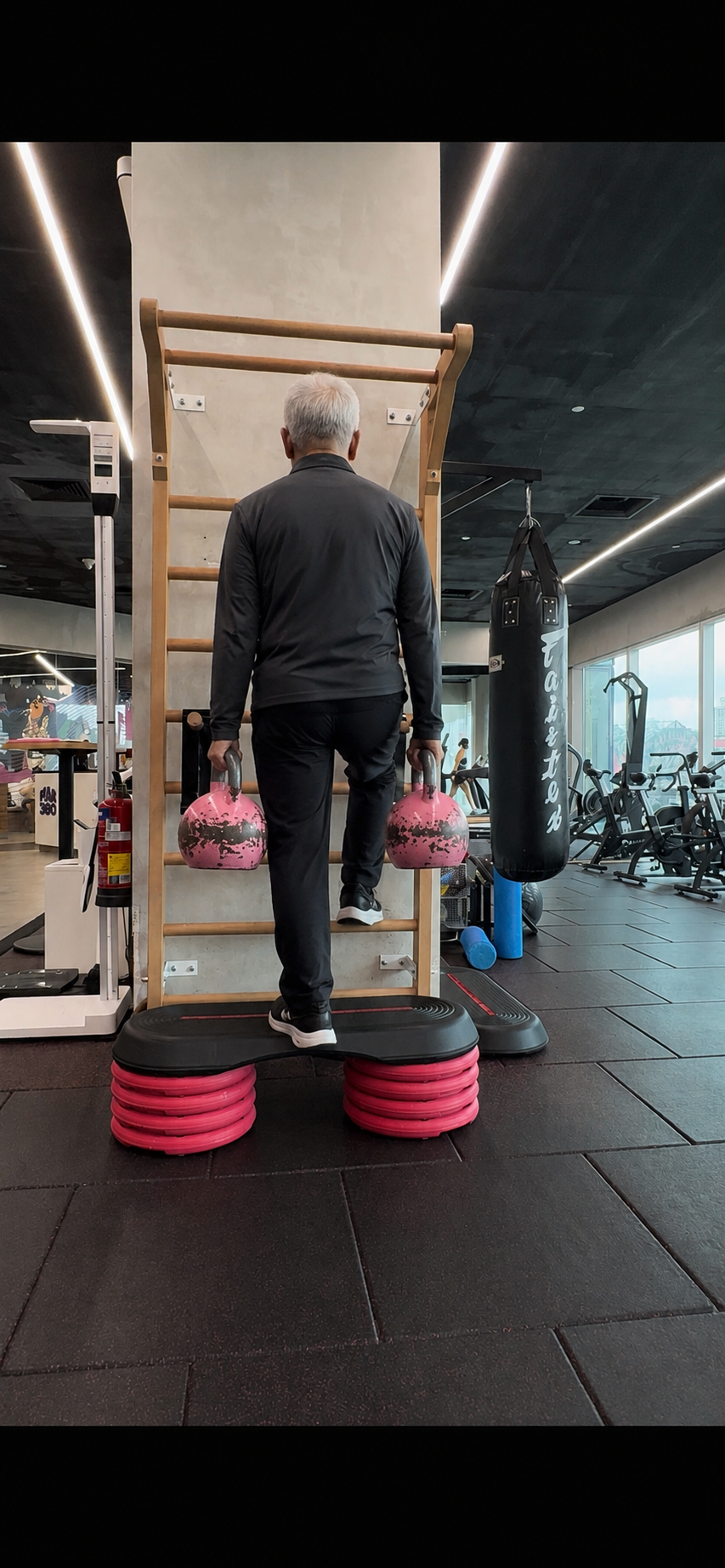
| Step-up onto a low step | 2 sets of 8 each leg | Knee in line over the foot |
| Cycling or walking | 10 to 20 minutes | Low-impact cardio, as CGH advises |
How much pain is fine? Dynamic Health says up to 4 out of 10 during exercise is acceptable if it eases within 45 minutes and does not affect your sleep or the next day. If it goes higher, cut the range or the reps, or pick an easier exercise. Exercise every other day, and expect 6 to 12 weeks for a good improvement, by the same source.
How does a coach train around hip pain at home or in a condo gym?
Inside your physio's plan, with the load raised a little at a time. A chair, a step, a band and a mat cover most of it, so a living room or condo gym works.
- 01Check the red flagsThe coach asks about the warning signs above before the first session. Any yes means a doctor first.
- 02Read the physio's planWhich condition, which exercises, which positions to avoid and the pain limit. The coach follows it and does not diagnose or treat.
- 03Set up the spaceA high, firm chair, a stable step and a mat. No low sofas for sit-to-stands.
- 04Progress slowlyA few more reps about every 2 weeks, then more load, as Dynamic Health describes, and back off when the next day is worse.
- 05Train the rest of youUpper body, core and cardio that keep the sore hip comfortable, such as cycling or swimming.
Who to see first is set out on physio or personal trainer. Knee pain that comes with the hip is on knee injury training.
Is it different if you are older or have weak bones?
Yes, in what else the plan protects. Three guides cover the overlap.
- 01Strength after 50Building muscle safely and the sarcopenia checks are on strength training after 50.
- 02OsteoporosisThe movements to change with low bone density are on exercise for osteoporosis.
- 03FallsBalance work and a safer home routine are on fall prevention exercises.
How do you start with a Fit Titans coach for hip pain?
Message us with your goal, what your doctor or physio said, and where you would like to train. A coach comes to your home, your condo gym, a park or a gym that allows outside trainers, and some coach online by video.
A 60-minute session with our coaches starts from S$50 (measured October 2026). The first session is a paid trial at 10% off the coach's rate. After it, sessions come in packs of 5, 10, 15 or 20, paid by PayNow. Home sessions are explained on home personal training.
Questions about hip pain exercises
What are the best hip pain exercises?
It depends on the cause. For hip osteoarthritis, strengthening and general fitness have strong support, such as bridges, sit-to-stands and mini squats. For outer hip pain, physios usually start with static holds and avoid moves that squash the tendon. Your physio's plan decides.
Should I stretch a sore hip?
The NHS suggests gentle hip stretching for general hip pain. For outer hip pain from gluteal tendinopathy, Cambridge University Hospitals advises avoiding buttock and ITB stretches and long end-range hip stretches.
Is walking good for hip arthritis?
Changi General Hospital lists walking, swimming and cycling as low-impact cardio choices for hip osteoarthritis, and advises avoiding high-impact activity such as running and jumping.
How should I sleep with outer hip pain?
Do not lie on the sore side. NHS hospital leaflets suggest a pillow between the knees, lying halfway between front and side, or lying on your back with pillows under your knees if both hips hurt.
When should I see a doctor for hip pain?
Go to A&E after a fall with severe pain or if you cannot put weight on the leg. See a doctor urgently for a hot, swollen hip or pain with a fever. See one soon if pain lasts over 2 weeks, affects sleep or keeps returning.

About this guide
Published
Sources (10) and terms used
Terms used
- Condo gym:
- The shared gym in a private condominium, run by the building's management.
Sources
- Hip pain (checked 8 Nov 2026) · NHS
- Osteoarthritis: treatment (checked 8 Nov 2026) · NHS
- Hip pain (checked 8 Nov 2026) · Dynamic Health, East of England Community Health and Care NHS Trust
- Hip osteoarthritis (checked 8 Nov 2026) · Changi General Hospital (SingHealth)
- Gluteal tendinopathy (checked 8 Nov 2026) · Cambridge University Hospitals NHS Foundation Trust
- Patient's guide to gluteal tendinopathy (checked 8 Nov 2026) · Royal National Orthopaedic Hospital NHS Trust
- Exercises for osteoarthritis of the hip (checked 8 Nov 2026) · Royal Orthopaedic Hospital NHS Foundation Trust
- Fransen et al. Exercise for osteoarthritis of the hip. Cochrane Database of Systematic Reviews 2014, CD007912 (checked 8 Nov 2026) · Europe PMC
- Kolasinski et al. 2019 ACR/Arthritis Foundation guideline for the management of osteoarthritis of the hand, hip, and knee. Arthritis Care and Research 2020, 72(2):149 (checked 8 Nov 2026) · Europe PMC
- Mellor et al. Education plus exercise versus corticosteroid injection use versus a wait and see approach for gluteal tendinopathy. BMJ 2018, 361:k1662 (checked 8 Nov 2026) · Europe PMC
General information, not medical advice.