

Squat form7 min read · Updated
How to Squat Properly: Steps, Depth and Common Mistakes
The short answer
Stand with feet slightly wider than hip width and toes turned slightly out, brace, then send the hips back and down while the knees bend together and track over the second toe.
- Go down until your thighs are about parallel, your heels start to lift or your back starts to round, whichever comes first (ACE).
- Knees moving a little past the toes is normal, and stopping them shifts load to the hips and lower back (Fry et al., 2003).
From S$50 a session. First session 10% off.
Written by the Fit Titans coaching team. Edited by Theon. How we write guides
This guide shows how to squat properly, one step at a time, then answers the questions people get stuck on: how deep to go, whether your knees can pass your toes and how to fix the common faults.
It also covers moving on to goblet and barbell squats, squatting at home and what to do first if you have a knee or back history.
On this page (9)
- 1. How do you do a bodyweight squat step by step?
- 2. How deep should you squat?
- 3. Can your knees go past your toes when you squat?
- 4. What are the most common squat mistakes and how do you fix them?
- 5. How do you progress from bodyweight to goblet and barbell squats?
- 6. Can you squat with a knee or back problem?
- 7. How do you practise squats at home with no equipment?
- 8. What does a coach watch for in your squat?
- 9. How do you start squatting with a Fit Titans coach?
Key facts
- Stopping the knees from passing the toes cut knee torque by about 22% but raised hip torque about tenfold in a 2003 barbell squat study (Fry et al.)
- A 2013 review found deep squats do not raise injury risk to the knee's passive tissues, provided technique is learned under supervision with gradual loads (Hartmann et al.)
- Full squats grew the glutes 6.7% against 2.2% for half squats over 10 weeks in a small trial of 17 men (Kubo et al., 2019)
How do you do a bodyweight squat step by step?
Feet a little wider than your hips, brace, sit the hips back and down, then stand up through your heels. These steps follow the American Council on Exercise bodyweight squat guide.
- 01Set your feetFeet slightly wider than hip width, toes turned slightly out, shoulder blades drawn down and back.
- 02BraceTighten your core, lift your chest and shift your weight toward your heels as the hips start to move back.
- 03LowerHips go back and down while the knees bend at the same time. Let the knees drift forward under control, with your back flat.
- 04Find the bottomStop when your thighs are about parallel, your heels start to lift or your torso starts to round. Knees stay over the second toe.
- 05Stand upBreathe out and push through your heels, with hips and chest rising together.
ACE says to breathe in on the way down and out on the way up. At the bottom, your shin and torso should look roughly parallel from the side, with your weight spread between the balls and heels of your feet.
How deep should you squat?
As deep as you can while your heels stay down and your back stays flat. ACE's stopping points are thighs about parallel, heels starting to lift or the torso starting to round. For many beginners the last two come first, and that is your depth for now.
| Study | What it found |
|---|---|
| Kubo, Ikebukuro and Yata, 2019 | 17 men trained full or half squats twice a week for 10 weeks. Full squats grew the glutes 6.7% and the adductors 6.2%, against 2.2% and 2.7% for half squats. Thigh growth was similar |
| Hartmann, Wirth and Klusemann, 2013 | A review that found deep squats do not raise injury risk to the knee's passive tissues, provided technique is learned under expert supervision with gradual increases in load |
Can your knees go past your toes when you squat?
Yes, a little is normal for most people. In a 2003 barbell squat study, Fry and colleagues stopped lifters' knees from passing their toes.
- 01Knees held backLifters' knees were stopped from passing their toes.
- 02Knee torque downBy about 22%.
- 03Hip torque upAbout tenfold, and the trunk leaned further forward.
- 04Stress shiftsThe authors concluded holding the knees back may shift stress to the hips and lower back.
The authors concluded that the knees may need to move slightly past the toes. ACE's guide also lets the knees drift forward under control. What matters more is that they track over the second toe.
What are the most common squat mistakes and how do you fix them?
Knees caving in, heels lifting and the back rounding at the bottom. The fixes below are coaching advice our coaches use, not medical advice.
| Fault | What you see | Common fix |
|---|---|---|
| Knees caving in | Knees drift inside the line of the feet on the way up | Slow the descent and think of pushing the knees out over the second toe. Use a lighter load |
| Heels lifting | Weight rolls onto the toes at the bottom | Stop just above where the heels rise, widen the stance slightly or hold a weight in front as a counterbalance |
| Back rounding | Lower back tucks under at the bottom | Squat to a box or chair at the depth where the back stays flat, then lower it over the weeks |
| Chest dropping | Torso folds forward, hips rise first on the way up | Brace before each rep and lead the stand with hips and chest together |
| Rushing | Bouncing out of the bottom | Lower over about 3 seconds and pause briefly before standing |
How do you progress from bodyweight to goblet and barbell squats?
Move on only when the current version looks the same on every rep. This order is coaching advice, and your coach may change it to suit you.
| Stage | What it is | Move on when |
|---|---|---|
| Box or chair squat | Sit back to a chair or box and stand up | You can stand up without rocking forward or using your hands |
| Bodyweight squat | The five steps above, no support | Depth and form hold for every rep of your sets |
| Goblet squat | A dumbbell or kettlebell held at the chest | Form holds with a weight you find challenging for your last few reps |
| Barbell back squat | Bar on the upper back, in a rack with safety bars set | Learned with a coach watching, starting light and adding load gradually |
How many sets, how often and how to add load for muscle gain are on how to build muscle in Singapore. Its weekly plans build each session on a squat or leg press.
Can you squat with a knee or back problem?
Often yes, but get the problem checked first and let the physio's plan come first. A coach does not diagnose or treat pain. See a doctor or physio before you squat if any of these apply.
- 01KneeIt is very painful, you cannot put weight on it, it is badly swollen or changed shape, or it locks, gives way or clicks painfully (NHS).
- 02Knee pain that lingersPain that does not improve within a few weeks (NHS).
- 03Back, urgentPain, tingling, weakness or numbness in both legs, or bladder or bowel changes. In Singapore, call 995 in an emergency (NHS).
- 04Back, see a GPPain that is worse at night, does not ease with rest or comes with unexplained weight loss (NHS).
- 01Get it checkedSee a doctor or physio first if any sign above applies.
- 02Physio's plan firstLet the physio's plan come first.
- 03Coach inside the limitsOnce cleared, a coach works inside the physio's limits.
How knee training builds back up is on knee injury training, and back pain on training with back pain.
How do you practise squats at home with no equipment?
A chair and a patch of floor are enough. Slow squats are quiet, so they suit a flat.
| Squat | How to do it | Why it helps |
|---|---|---|
| Chair squat | Sit back until you touch the seat, then stand | Use a higher chair if your heels lift |
| Slow squat | 3 seconds down and a short pause at the bottom | Makes bodyweight harder without jumping |
| Backpack goblet squat | Hug a loaded backpack to your chest | Takes the place of a dumbbell |
| Split squat | One foot forward, one back, lowering straight down | Works one leg at a time |
A full quiet routine for a flat is in the HDB living room workout. When you are ready for a dumbbell or a rack, see home gym setup in Singapore.
What does a coach watch for in your squat?
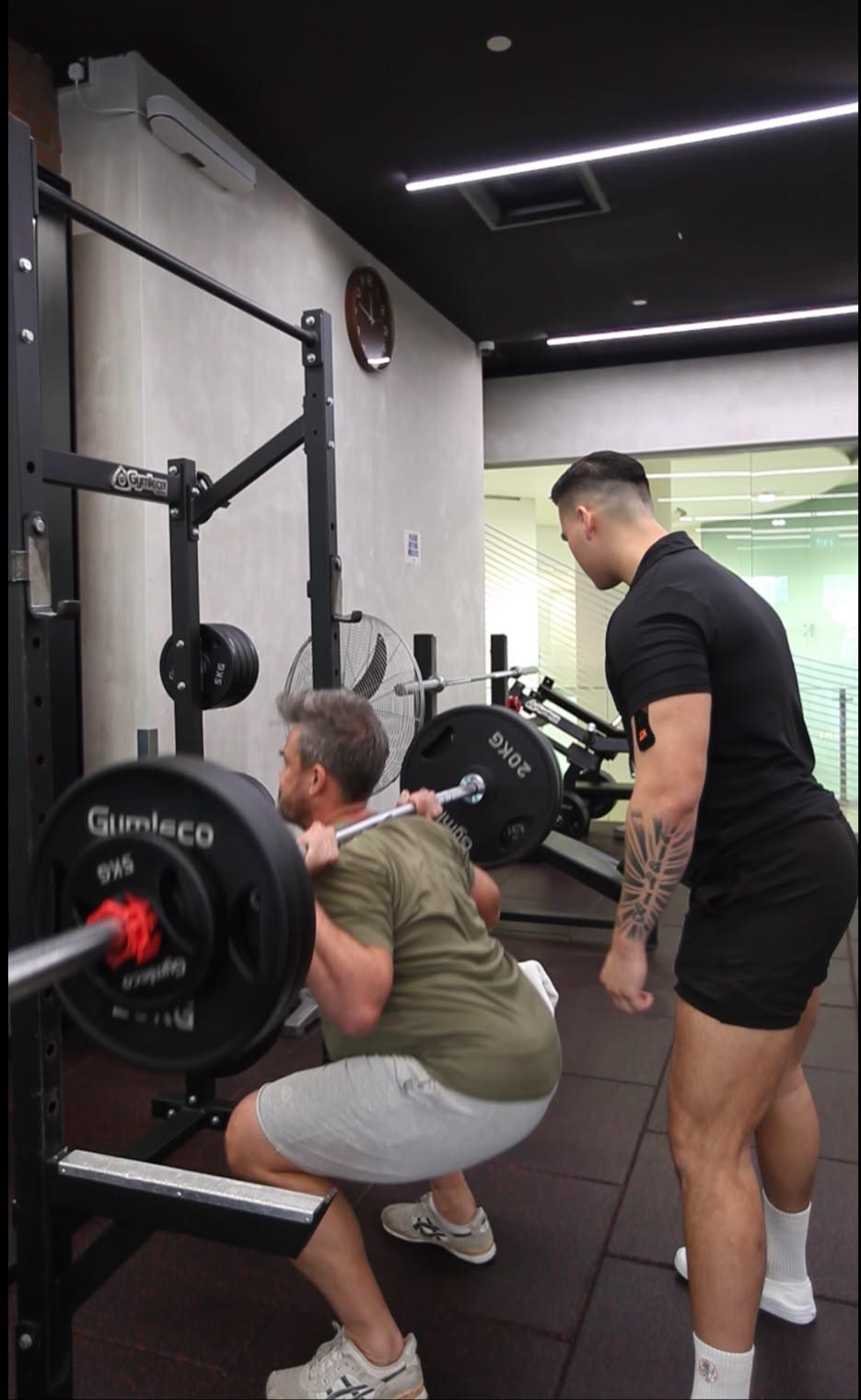
How you move from the side and the front, rep after rep. This checklist is coaching practice, not a medical assessment.
- 01FeetHeels down and weight spread across the whole foot.
- 02KneesTracking over the second toe, not caving in on the way up.
- 03BackFlat at your depth, with no tuck at the bottom.
- 04TempoA controlled descent and no bounce.
- 05LoadAdded only when every rep of the last session looked the same.
How do you start squatting with a Fit Titans coach?
Message us with your goal, any knee or back history and where you would like to train. A coach comes to your home, your condo gym, a park or a gym that allows outside trainers, and some coach live by video.
A 60-minute session with our coaches starts from S$50 (measured October 2026). The first session is a paid trial at 10% off the coach's rate. After it, sessions come in packs of 5, 10, 15 or 20, paid by PayNow. See home personal training.
Questions about how to squat properly
Should your knees go past your toes when you squat?
A little is normal. In a 2003 study, stopping the knees from passing the toes cut knee torque by about 22% but raised hip torque about tenfold and increased forward lean. The authors suggested the knees may need to move slightly past the toes.
How low should you squat?
ACE says to lower until your thighs are about parallel, your heels start to lift or your torso starts to round. Stop at whichever comes first and work on depth over time.
Are deep squats bad for your knees?
A 2013 review in Sports Medicine found deep squats do not raise injury risk to the knee's passive tissues, provided technique is learned under expert supervision with gradual increases in load. If you have knee pain, see a doctor or physio first.
Should you do goblet squats before barbell squats?
Our coaches usually start with box squats, then bodyweight and goblet squats before a barbell, moving on once form holds on every rep. That order is coaching advice, not a rule.
Can you squat every day?
It depends on the load and how you recover. How many sessions a week build muscle is covered on our muscle-building guide, and a coach sets the plan around your recovery.
About this guide
Published
Sources (6) and terms used
Terms used
- ACE:
- American Council on Exercise, a US certifying body for personal trainers, with specialist add-ons such as Senior Fitness Specialist.
Sources
- Bodyweight squat, exercise library (checked 8 Nov 2026) · American Council on Exercise
- Fry, Smith and Schilling. Effect of knee position on hip and knee torques during the barbell squat. J Strength Cond Res 2003, 17(4):629 (abstract read on Europe PMC, checked 8 Nov 2026) · PubMed, National Library of Medicine
- Hartmann, Wirth and Klusemann. Analysis of the load on the knee joint and vertebral column with changes in squatting depth and weight load. Sports Med 2013, 43(10):993 (abstract read on Europe PMC, checked 8 Nov 2026) · PubMed, National Library of Medicine
- Kubo, Ikebukuro and Yata. Effects of squat training with different depths on lower limb muscle volumes. Eur J Appl Physiol 2019, 119(9):1933 (abstract read on Europe PMC, checked 8 Nov 2026) · PubMed, National Library of Medicine
- Knee pain (checked 8 Nov 2026) · NHS
- Back pain (checked 8 Nov 2026) · NHS
General information, not medical advice.