


Strength7 min read · Updated
How to Do a Pull Up: From Zero to Your First Rep
The short answer
A pull-up lifts your whole bodyweight with your back and arms, so it depends on strength relative to bodyweight, grip and shoulder-blade control.
- Build it in stages: dead hangs, scapular pulls, inverted rows, band-assisted reps and slow negatives, then single full reps.
- How long it takes varies a lot.
- In one University of Dayton study, 4 of 17 women who trained for three months could do a pull-up at the end.
- A chin-up, palms facing you, is often the easier first rep.
From S$50 a session. First session 10% off.
Written by the Fit Titans coaching team. Edited by Theon. How we write guides
This guide shows how to do a pull up if you are an adult who cannot do a single rep today.
It covers why the move is hard, a step-by-step progression from hanging to your first full rep, how often to train, the mistakes that stall people, pull-up versus chin-up and where to train in Singapore. The progression is coaching advice, not medical advice.
On this page (9)
- 1. Why is a pull-up so hard for beginners?
- 2. What is the best progression to your first pull-up?
- 3. How do you do a pull-up with good form?
- 4. How often should you train for a pull-up?
- 5. How long does it take to do your first pull-up?
- 6. What are the most common pull-up mistakes?
- 7. Pull-up or chin-up: which should you learn first?
- 8. Where can you train pull-ups in Singapore?
- 9. What does a coach add when you are learning pull-ups?
Key facts
- ACE describes the pull-up as lifting your full bodyweight against gravity, led by the lats, rhomboids, rear shoulders and biceps
- In an EMG study of 25 adults, the lats were the most active muscle in both pull-ups and chin-ups (Youdas et al. 2010)
- The chin-up worked the biceps and chest harder, the pull-up the lower trapezius (Youdas et al. 2010)
- Women who reached a pull-up after training had a higher strength-to-mass ratio (Flanagan et al. 2003)
Why is a pull-up so hard for beginners?
Because you lift your full bodyweight with your upper body. ACE calls it a test of upper-body strength and trunk stability, led by the lats, rhomboids, rear shoulders and biceps. Three things usually hold people back.
- 01GripYou have to hold the bar long enough to finish the rep. ACE lists the flexed-arm hang as a way to build grip strength.
- 02Shoulder-blade controlIn an EMG study, pull-ups and chin-ups were started by the lower trapezius and chest and finished by the biceps (Youdas et al.). If the shoulder blades do not move first, the arms tire early.
- 03Strength relative to bodyweightIn a training study of college-age women, those who managed a pull-up had greater strength and a higher strength-to-mass ratio than those who did not (Flanagan et al.).
Limb length matters too. Researchers quoted by The Globe and Mail said tall, long-limbed people find pull-ups harder whatever their gender. Youdas et al. found the lats were the most active muscle, at 117 to 130% of maximum effort.
What is the best progression to your first pull-up?
Six stages, each building what the next one needs. This is the order our coaches use with adults. It is coaching advice, not a fixed rule, and you move on when you meet the check, not when a week ends.
| Stage | What you do | Move on when |
|---|---|---|
| 1. Dead hang | Hang from the bar, arms straight, thumbs wrapped round. 3 to 4 holds | You can hang about 30 seconds without your grip failing |
| 2. Scapular pull | From the hang, pull the shoulder blades down and together without bending the elbows, then relax. 3 sets of 6 to 8 | You can lift your body a little with arms straight |
| 3. Inverted row | Lie under a low bar, heels on the floor, body straight, pull your chest to the bar. 3 sets of 8 to 12 | 12 clean reps with the bar low and your body near flat |
| 4. Band-assisted pull-up | Loop a band over the bar and put a foot or knee in it. 2 to 4 sets of 8 to 12 | 8 or more clean reps on your thinnest band |
| 5. Negative | Step up so your chin is over the bar, then lower yourself slowly to straight arms. 3 sets of 3 to 5 | You can take about 5 seconds to lower and control the whole way |
| 6. First full rep | Single reps from a dead hang, with full rest between. Keep some band and negative work | Chin clears the bar with no swing or kick |
The band and negative stages come from ACE's pull-up article, which suggests 2 to 4 sets of 8 to 12 reps for assistance work and says a thicker or thinner band changes how much help you get. ACE's chin-up guide lists low-bar chin-ups with feet on the ground, the same idea as the inverted row.
How do you do a pull-up with good form?
Set the shoulders, then pull the elbows down. These steps follow the ACE exercise library.
- 01GripPalms facing away, a full grip with thumbs wrapped round the bar, wrists straight.
- 02BraceCross one leg over the other, tighten your stomach and keep your head in line with your body.
- 03Set the shouldersPull the shoulder blades back and down before your elbows bend. ACE likens it to putting them in your back pocket.
- 04PullDrive the elbows down towards your sides until your chin is level with the bar. No swinging.
- 05LowerPause, then straighten your arms slowly back to the hang and keep the shoulder position.
How often should you train for a pull-up?
Two or three short sessions a week, with a rest day between, suits most beginners. That is coaching advice, not a research figure.
- MonDead hangsInverted rowsBand-assisted pull-ups
- TueRest
- WedScapular pullsNegativesInverted rows
- ThuRest
- FriDead hangsBand-assisted pull-upsOne or two attempts at a full rep
- SatRest
- SunRest
Go easy on negatives. ACE notes that slow lowering work brings more soreness after training, so start with a few reps and add more over the weeks.
How long does it take to do your first pull-up?
It varies too much to promise a number. Starting strength, bodyweight, limb length and how often you train all change it.
So three months may not be enough for everyone, and that is normal. The published study found the women who succeeded were stronger for their size, with a higher strength-to-mass ratio, and used body fat to help predict who would succeed. Getting stronger and, if it suits your goals, a little leaner both help. Muscle building is covered in how to build muscle.
What are the most common pull-up mistakes?
Most come from chasing the rep instead of the movement. The first three are from ACE's guides.
The mistake
- Swinging or kicking: ACE says momentum reduces grip control and raises injury risk.
- Half reps: jumping to the bar or stopping halfway down.
- Losing the shoulder position: shrugging up towards the ears.
- Dropping on the way down: the lowering half left uncontrolled.
- Skipping stages: going straight to negatives before you can hang and row. This is coaching advice from what we see.
The fix
- Brace and cross your ankles.
- Go from straight arms to chin over the bar.
- Draw the shoulder blades down instead.
- Control it. The lowering half builds strength too.
- Learn to hang and row first.
Pull-up or chin-up: which should you learn first?
Many people find the chin-up easier, so it is a sensible first goal. The difference is the grip.
Pull-up
- Palms facing away
- Lower trapezius more active (Youdas et al.)
- Lats do most of the work
Chin-up
- Palms facing you
- Biceps and chest more active (Youdas et al.)
- A coach in ACE's guide finds it easier because the biceps help
The lats were the most active muscle in both. Learn the chin-up first if it comes sooner, then add pull-ups once you have a few clean reps.
Where can you train pull-ups in Singapore?
Almost anywhere with a bar. MCCY says there are over 3,400 fitness corners across HDB estates, Sport-in-Precinct facilities and NParks parks. Equipment differs from corner to corner, so check for a bar before you go.
- 01Fitness corners and parksLook for a high bar for hangs and a low bar for inverted rows. Train early or late to avoid the midday heat.
- 02Condo gymsMany have a pull-up station or cable machine. A coach can train you there, see condo gym personal training.
- 03A doorway bar at homeCheap and always there. Load ratings, mounting and what to buy are on home gym setup in Singapore.
What does a coach add when you are learning pull-ups?
A coach sees what you cannot feel and picks the right stage for this week.
- 01Find your stageA quick test of your hang, rows and band reps shows where to start.
- 02Fix the set-upShoulder position, grip and bracing, checked rep by rep.
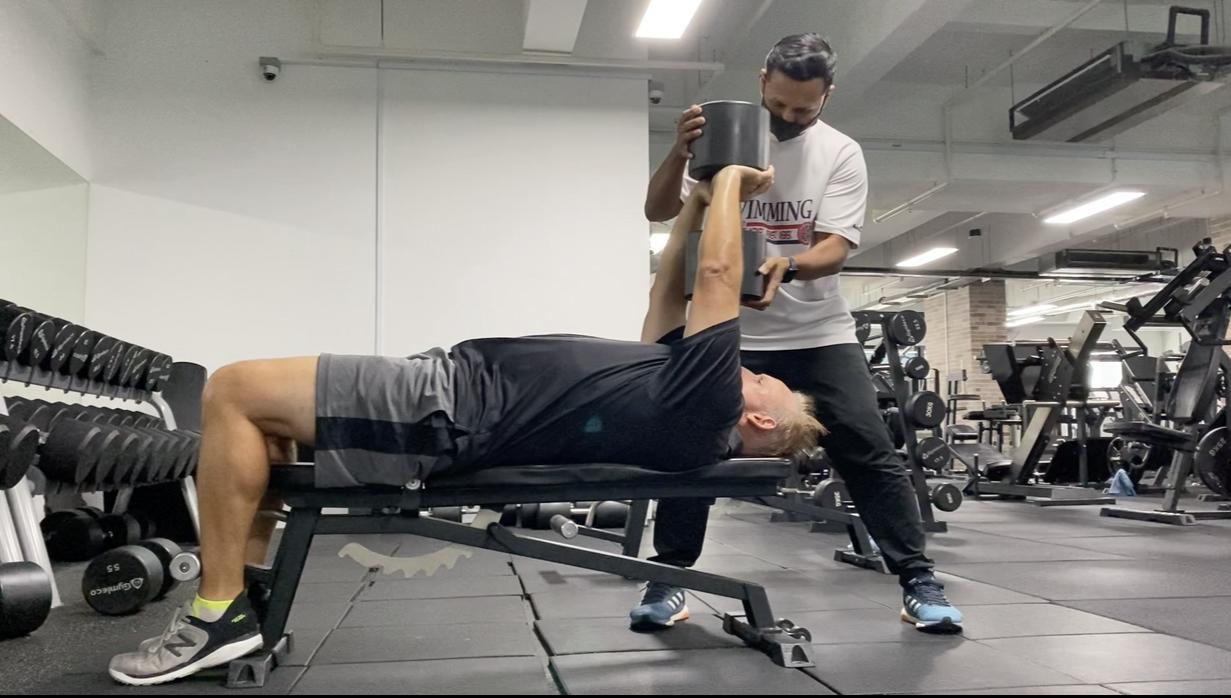
- 03Spot and assistACE's chin-up guide lists a trainer's hand assist as a step between bands and full reps.
- 04Build the rest of youRows, pulldowns and whole-body strength so the pull-up is part of a plan, not a single goal.
Women working towards a first pull-up may also like strength training for women. Students training for the test should use NAPFA pull-ups and sit-ups, which has the grade tables. For the wider test plan, see IPPT and NAPFA training.
A coach comes to your home, your condo gym, a park or a gym that allows outside trainers, and some coach online by video. A 60-minute session with our coaches starts from S$50 (measured October 2026). The first session is a paid trial at 10% off the coach's rate. After it, sessions come in packs of 5, 10, 15 or 20, paid by PayNow.
Questions about first pull-up
How can I do a pull-up if I cannot do one at all?
Work through stages: dead hangs, scapular pulls, inverted rows, band-assisted pull-ups and slow negatives, then single full reps. This is coaching advice and the pace varies.
Is a chin-up easier than a pull-up?
For many people, yes. In an EMG study the chin-up, palms facing you, used the biceps and chest more, while the pull-up used the lower trapezius more. The lats did most of the work in both (Youdas et al. 2010).
How long does it take to get your first pull-up?
It varies. In a University of Dayton study reported by The Globe and Mail, 4 of 17 women who could not do a pull-up managed one after three months of training. Strength relative to bodyweight was linked to success.
Are negative pull-ups good for beginners?
Yes, once you can hang and row. ACE says lowering more slowly makes them harder and that this kind of work brings more soreness afterwards, so start with a few reps.
Can I train pull-ups at home in Singapore?
Yes. A doorway bar, a band and a low bar for rows cover every stage. Check the bar's load rating first.

About this guide
Published
Sources (7) and terms used
Terms used
- ACE:
- American Council on Exercise, a US certifying body for personal trainers, with specialist add-ons such as Senior Fitness Specialist.
Sources
- Youdas et al. Surface electromyographic activation patterns and elbow joint motion during a pull-up, chin-up, or Perfect-Pullup rotational exercise. J Strength Cond Res 2010 (abstract checked 8 Nov 2026) · Europe PMC
- Flanagan, Vanderburgh, Borchers and Kohstall. Training college-age women to perform the pull-up exercise. Res Q Exerc Sport 2003 (abstract checked 8 Nov 2026) · Europe PMC
- Even fit women can't do pull-ups, study finds (checked 8 Nov 2026) · The Globe and Mail
- 4 moves to help you master the pull-up, Jacqueline Crockford, 2015 (checked 8 Nov 2026) · American Council on Exercise
- ACE technique series: chin-ups, Pete McCall, ProSource February 2016 (checked 8 Nov 2026) · American Council on Exercise
- Exercise library: pull-ups (checked 8 Nov 2026) · American Council on Exercise
- Publicly accessible fitness facilities, parliamentary answer, 12 Feb 2026 (checked 8 Nov 2026) · Ministry of Culture, Community and Youth
General information, not medical advice.