
Bone health8 min read · Updated
Exercise for Osteoporosis in Singapore
The short answer
With osteoporosis or osteopenia, the evidence supports three things after your doctor's advice: progressive resistance training on 2 or 3 days a week, moderate impact such as hopping or jogging on most days if you have no spinal or multiple fractures, and balance work at least twice a week.
- Avoid heavy forward bending of the spine, especially with a weight.
- After a vertebral fracture, keep impact to brisk walking and start with a physiotherapist.
From S$50 a session. First session 10% off.
Written by the Fit Titans coaching team. Edited by Theon. How we write guides
Exercise for osteoporosis is not only walking.
Singapore's national guideline asks for weight-bearing, muscle-strengthening and balance exercise, and a UK expert consensus sets out how much. This page covers what osteoporosis and osteopenia are, what exercise the evidence supports, which movements to change, and how a coach trains it once your doctor has advised you. It is general information, not medical advice.
On this page (11)
- 1. What is osteoporosis, and what is osteopenia?
- 2. How common are osteoporotic fractures in Singapore?
- 3. Should you see a doctor before exercising with osteoporosis?
- 4. What exercise is best for osteoporosis?
- 5. Is heavy lifting safe with osteoporosis?
- 6. Which exercises should you avoid with osteoporosis?
- 7. How do you start and progress exercise for osteoporosis?
- 8. Can exercise help bone health before osteoporosis starts?
- 9. When should you stop and see your doctor?
- 10. How does a personal trainer help with osteoporosis exercise?
- 11. How do you start with a Fit Titans coach?
Key facts
- Osteoporosis is diagnosed by a fragility fracture or a DXA T-score of -2.5 or lower at the hip or spine (ACE, MOH Singapore, 2025)
- From 2017 to 2022, hip fracture hospitalisations in Singapore residents aged 50 and over fell from 248 to 219 per 100,000 in women and 125 to 106 in men (ACE 2025)
- Singapore's guideline encourages weight-bearing, muscle-strengthening and balance exercise, such as walking, resistance bands, dumbbells and Tai Chi
- The UK consensus advises strength work on 2 or 3 days a week, at a weight you can lift 8 to 12 times, building to 3 sets
What is osteoporosis, and what is osteopenia?
Osteoporosis means the density and quality of your bones have dropped, so they break more easily. HealthHub calls it a silent disease, usually found only after a fracture. Singapore's ACE Clinical Guideline, from the Ministry of Health, defines it by a scan result or a broken bone.
| T-score | What it means | What usually follows |
|---|---|---|
| -1.0 or higher | Normal bone density | Healthy habits, reassess if risk changes |
| Between -1.0 and -2.5 | Low bone mass, often called osteopenia | Your doctor weighs fracture risk to decide on medicine |
| -2.5 or lower | Osteoporosis | Diagnosis and treatment |
| Any score with a fragility fracture | Osteoporosis | Diagnosis and treatment |
A fragility fracture is a break from minimal trauma, such as a fall from standing height. ACE lists early menopause at 45 or younger, a family history of osteoporosis or fragility fractures, and height loss of more than 2cm in 3 years among the signs that call for a check.
How common are osteoporotic fractures in Singapore?
Common enough that MOH calls osteoporosis a major public health concern. ACE gives these rates for Singapore residents aged 50 and over, adjusted for age:
| Fracture | Women | Men |
|---|---|---|
| Hip fracture hospitalisations, 2017 | 248 | 125 |
| Hip fracture hospitalisations, 2022 | 219 | 106 |
| Spine, upper arm and wrist fracture visits, 2017 to 2022 | Stable at about 708 | Rose from 289 to 323 |
The rate per person has fallen, but ACE notes that the total number of fractures keeps rising as Singapore ages. HealthHub adds that one in three people with a hip fracture loses some function, such as walking.
Should you see a doctor before exercising with osteoporosis?
Yes. Your doctor holds the facts that set your plan: the scan, your fracture history and your medicine. HealthHub advises checking with a doctor first, especially with bone loss.
- 01DoctorHolds your scan, fracture history and medicine. HealthHub advises checking with a doctor first.
- 02PhysiotherapistAt least at the start for anyone with vertebral or multiple low-trauma fractures, per the UK consensus.
- 03CoachTrains within what your doctor or physiotherapist has cleared.
- 01Your DXA resultThe T-score at the hip and spine, and the date of the scan.
- 02Fracture historyAny broken bone after 50, and any spinal fracture, even one found only on an X-ray.
- 03MedicineWhat you take for bone, and any steroid use. Your doctor manages it. A coach never changes it.
- 04Impact and liftingAsk plainly whether jumping, jogging and loaded lifts are fine for you.
What exercise is best for osteoporosis?
A mix of resistance, impact and balance work, not walking alone. ACE encourages weight-bearing, muscle-strengthening and balance exercise. The Strong, Steady and Straight consensus (Brooke-Wavell et al., British Journal of Sports Medicine, 2022) sets out the dose:
| Type | How often | How much | Examples |
|---|---|---|---|
| Resistance | 2 or 3 days a week | A weight you can lift 8 to 12 times, building to 3 sets, all major muscles including the back | Squats, rows, presses, deadlift with a straight back |
| Impact, no spinal or multiple fractures | Most days | At least 50 moderate impacts, for example 5 sets of 10 | Jogging, hopping, low jumps |
| Impact, after spinal or multiple fractures | Most days | No harder than brisk walking, about 150 minutes a week | Brisk walking |
| Balance | At least twice a week | Combined with strength work | Tai Chi, dance, yoga, Pilates |
| Back extension | At least twice a week, daily after a spinal fracture | 3 to 5 repeats, held 3 to 5 seconds | Lying back raises, wall-supported extension |
The Bone Health & Osteoporosis Foundation gives the same split. High-impact moves build bone, and low-impact ones such as brisk walking or an elliptical suit people who cannot do high impact. Singapore General Hospital advises low-impact weight-bearing activity 2 to 3 times a week, for at least 30 minutes each time.
Is heavy lifting safe with osteoporosis?
It can be, built up slowly with good technique. The UK consensus advises progressive loading and argues against rigid rules about never lifting.
- FirstLower loadsClean technique first.
- ThenProgressive loadingBuilt up slowly, not rigid rules about never lifting.
- ThroughoutSupervisedSupervised training where possible.
One trial tested heavier lifting under close supervision in women with low bone mass. Our strength training after 50 guide covers what it found and who it applies to. Treat it as a reason to build up, not a reason to start heavy.
Which exercises should you avoid with osteoporosis?
Heavy or repeated forward bending of the spine is the main one, especially with a weight. The UK consensus is specific:
| Movement | What the consensus says | What a coach uses instead |
|---|---|---|
| Weighted sit-ups and crunches | Avoid postures with a high degree of spinal flexion, especially weighted | Planks, dead bugs, back extension |
| Repeated or end-range forward bending | Modify or avoid sustained, repeated or end-range flexion | Hip hinge with a straight back |
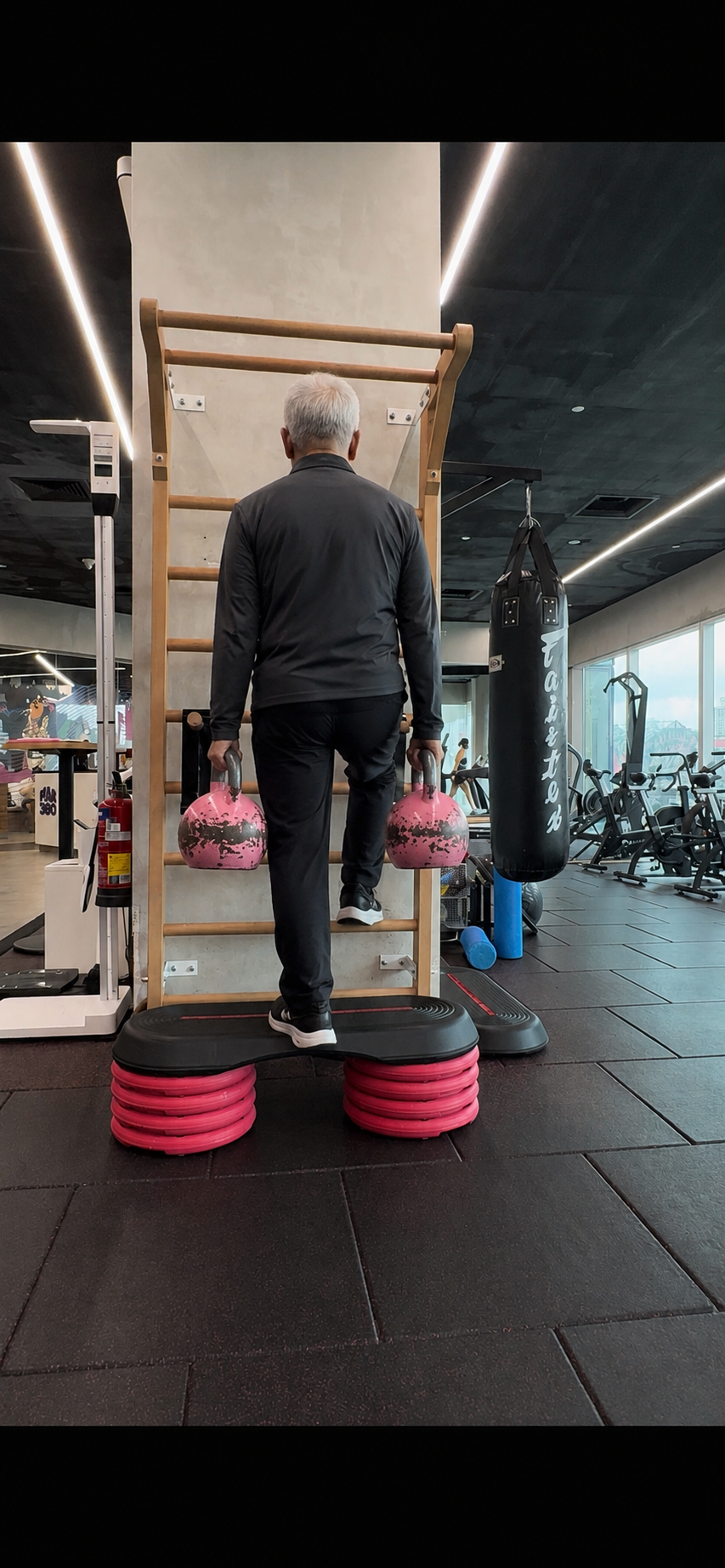
| Lifting with a rounded back | Keep the upper back straight, neck in line, bend at the hips | Deadlift or kettlebell lift from a raised height |
| Twisting | Fine if smooth and comfortable | Slow, controlled rotation, no fast loaded twists |
| Jumping after a spinal fracture | Keep impact to about brisk walking | Brisk walking, step-ups |
The BHOF also says high-impact exercise may need to be avoided if you have broken a bone from osteoporosis or are at risk of one. Check with your doctor if you are unsure.
How do you start and progress exercise for osteoporosis?
Start light, learn the movements, then add one thing at a time. HealthHub suggests starting slowly with rest between workouts, and the UK consensus asks for technique before load.
- 01Weeks 1 to 4: techniqueBodyweight squats to a chair, wall push-ups, band rows, back extensions and calf raises. Learn the hip hinge so bending never rounds the spine.
- 02Weeks 5 to 12: add loadDumbbells or a goblet squat, at a weight you can lift 8 to 12 times, building from 1 set to 3. Two or three sessions a week.
- 03Add impact if clearedHeel drops and small hops in short bursts, working toward 50 impacts a session on most days. Skip this step after a spinal fracture.
- 04Keep balance inSingle-leg stands, heel-to-toe walks and step-ups, at least twice a week, near a wall or counter.
- 05Keep progressingMore weight, more sets or a harder variation, one change at a time. The consensus calls for progressive loading, not the same weight forever.
For a full falls routine at home, see our fall prevention exercises guide. If muscle loss is part of the picture, read about training for sarcopenia.
Can exercise help bone health before osteoporosis starts?
Yes, and midlife is when it matters most. HealthHub says bone growth peaks before 30 and recommends weight-bearing and resistance exercise to keep bones strong.
- Before 30Bone growth peaksPer HealthHub.
- MidlifeKeep bones strongHealthHub recommends weight-bearing and resistance exercise.
- Menopause at 45 or youngerA risk factorACE flags early menopause as a risk factor.
Women around menopause will find the same resistance and impact mix in our menopause strength training plan.
When should you stop and see your doctor?
Stop the session and contact your doctor for new back pain, a fall, or any sign of a break. The ACE guideline links height loss and lower back pain with possible spinal fractures.
Stop and contact your doctor
- New back pain: especially low back pain that was not there before
- Getting shorter: more than 2cm in 3 years
- Any fall: even without obvious injury, tell your doctor and your coach
Emergency
- A suspected broken bone with severe pain
- In Singapore, call 995
How does a personal trainer help with osteoporosis exercise?
A coach turns your doctor's advice into weekly sessions and watches every rep. Coaches are not medical professionals. They do not diagnose, treat or change medicine. They train within what your doctor or physiotherapist has cleared.
- 01Technique firstA straight back on every lift, the hip hinge on every bend.
- 02Steady progressionA log of weights, sets and how you felt, so load rises on schedule.
- 03Safe impactHops and heel drops only when cleared, in short counted bursts.
- 04Balance with supportNear a wall or rail, with the coach standing close.
- 05A report for your doctorBring the log to your next review.
Most sessions need only dumbbells, bands and a step, so they work in a living room or a condo gym. More on coached sessions at home is on our home personal training page.
How do you start with a Fit Titans coach?
Message us with your scan result, any fracture history and what your doctor said about lifting and impact. A coach comes to your home, your condo gym, a park or a gym that allows outside trainers. The first session is a paid trial at 10% off the coach's rate. After it, sessions come in packs of 5, 10, 15 or 20, paid by PayNow.
Questions about osteoporosis exercise
What is the best exercise for osteoporosis?
A mix of progressive resistance training on 2 or 3 days a week, moderate impact on most days if you have no spinal or multiple fractures, and balance work at least twice a week, per the UK Strong, Steady and Straight consensus. Singapore's ACE guideline also encourages weight-bearing, muscle-strengthening and balance exercise. Ask your doctor first.
Is walking enough for osteoporosis?
Walking helps, but it is not the whole plan. The UK consensus adds resistance training and, where safe, impacts harder than walking such as hopping or jogging. After a vertebral fracture, brisk walking is the impact level it recommends.
Can I do squats and deadlifts with osteoporosis?
Often yes, with good technique and gradual loading once your doctor agrees. The UK consensus advises a straight upper back, bending at the hips and avoiding loaded forward bending of the spine. Start light and build up.
Should I avoid sit-ups with osteoporosis?
The UK consensus advises avoiding postures with a high degree of spinal flexion, especially with a weight. Weighted sit-ups and crunches fit that description. Planks and back extensions train the trunk without it.
Can exercise reverse osteoporosis?
Exercise supports bone strength and helps prevent falls, but it is not a treatment on its own. Diagnosis and medicine stay with your doctor. A coach trains within that plan and does not promise to reverse a scan result.

About this guide
Published
Sources (5) and terms used
Terms used
- ACE:
- American Council on Exercise, a US certifying body for personal trainers, with specialist add-ons such as Senior Fitness Specialist.
- Menopause:
- The point when you have gone 12 months without a period.
- Hinge:
- The hip-dominant movement pattern of a deadlift or kettlebell swing: hips travel back, spine stays neutral, hamstrings and glutes do the work.
Sources
- ACE Clinical Guideline: Osteoporosis, diagnosis and management, version 2.0, 15 Aug 2025 (checked 8 Nov 2026) · Agency for Care Effectiveness, Ministry of Health Singapore
- Keeping bones strong with exercise and calcium-rich foods, reviewed 15 Nov 2022 (checked 8 Nov 2026) · HealthHub, Health Promotion Board
- Osteoporosis, Orthopaedic Surgery, Singapore General Hospital (checked 8 Nov 2026) · SingHealth
- Brooke-Wavell et al. Strong, steady and straight: UK consensus statement on physical activity and exercise for osteoporosis. Br J Sports Med 2022, 56(15) (checked 8 Nov 2026) · British Journal of Sports Medicine, via PubMed Central
- Be Bone Strong: exercise and safe movement (checked 8 Nov 2026) · Bone Health & Osteoporosis Foundation
General information, not medical advice.