Shoulder8 min read · Updated
Training After a Shoulder Labral Tear
The short answer
A labral tear is a tear in the rim of cartilage that deepens the shoulder socket: a SLAP tear sits at the top, and a Bankart tear at the front and lower part, usually after a dislocation (AAOS).
- After repair, AAOS says the shoulder should be fully healed in 4 to 6 months, and Tan Tock Seng Hospital's guide puts strengthening at 3 to 4 months and a return to activities after 6 months.
- A coach comes in late, for strength and controlled range inside your physio's limits, and does not diagnose or treat the tear.
From S$50 a session. First session 10% off.
Written by the Fit Titans coaching team. Edited by Theon. How we write guides
This page is for adults in Singapore who already have a labral tear diagnosed and want to get back to the gym.
It covers what the tear is, the two treatment paths, how long hospitals and clinics say recovery takes, and what a coach does once your physio or surgeon clears you for gym work. It is general information, not medical advice.
On this page (10)
- 1. What is a shoulder labral tear?
- 2. Who should manage a labral tear first?
- 3. Does a labral tear need surgery?
- 4. How long until you can go back to the gym?
- 5. When can a personal trainer help with a labral tear?
- 6. What does a coach do in the late stage?
- 7. Which lifts should you modify after a labral tear?
- 8. How do your coach and physio share the plan?
- 9. Is it different if you are over 50?
- 10. How does training with a Fit Titans coach work?
Key facts
- After labral repair, a sling is usually worn for 2 to 6 weeks, and AAOS advises lifting nothing over about 2 kg for up to 12 weeks
- Treatment starts with a doctor and a physio, and surgery is considered if that does not settle the symptoms (AAOS)
- In a Singapore study of 82 shoulders after Bankart repair, 59.8% returned to sport and 9.8% reported a repeat dislocation (Singapore Medical Journal)
What is a shoulder labral tear?
It is a tear in the labrum, a rim of cartilage that deepens the shoulder socket. The American Academy of Orthopaedic Surgeons (AAOS) says the labrum also anchors some shoulder ligaments and one of the biceps tendons.
A tear can follow a fall on an outstretched arm, a direct blow, a sudden pull or a violent overhead reach. AAOS adds that repeated overhead work can cause it too, in throwing athletes and weightlifters.
| Tear | Where it is | Usual cause |
|---|---|---|
| SLAP | The top of the labrum, front to back. It may involve where the biceps tendon starts | Falls, sudden pulls, overhead reaching and repeated overhead sport |
| Bankart | The front and lower part of the labrum | Usually a front shoulder dislocation |
AAOS lists the common symptoms as a sense that the shoulder is unstable, deep pain with overhead or reaching movements, catching or popping, pain at night, less range and weakness. Only a doctor's examination, and often a scan, can confirm a tear.
Who should manage a labral tear first?
A doctor and a physiotherapist. They confirm the tear, decide whether it needs surgery and set what you may load and when. A coach starts only after that, working to their limits. The wider question of who to see after any injury, and how to get subsidised physio in Singapore, is covered in physio or personal trainer after an injury.
Go to A&E now if the shoulder looks out of place or has changed shape, you cannot move the arm, or it is painful, bruised or swollen after an injury. The NHS lists these as signs of a dislocation. Do not drive yourself there.
- 01See your doctor or physio againIf the shoulder feels like it slips or gives way, catches or locks, or wakes you at night.
- 02Stop a sessionFor sharp pain, new numbness or tingling into the hand, or a feeling of instability. A coach should stop it too.
- 03After surgery,Any new pain, swelling or loss of movement goes to your surgical team first, not to a coach.
Does a labral tear need surgery?
Not always. AAOS says early care can be anti-inflammatory medicine, rest and rotator cuff exercises, then physiotherapy for motion and strength, and sometimes a brace for ongoing instability.
Surgery may be recommended if that does not fully settle the symptoms, if they come back, or sometimes after a first dislocation. Physio & Sole, a Singapore physio clinic, adds that surgery may be considered when conservative care does not get you back to your previous level of sport.
Conservative path
- Rest and anti-inflammatory medicine early on (AAOS)
- Physio for range, strength and control, plus home exercises
- Rotator cuff and biceps work
- A brace in some cases of ongoing instability
Surgical path
- Usually arthroscopic, through small cuts (AAOS)
- SLAP: the torn part may be removed, or the biceps tendon repaired, released or moved
- Bankart: the labrum and ligaments are reattached with suture anchors
- A sling, then a phased physio programme
How long until you can go back to the gym?
After surgery, months rather than weeks. The sources below give ranges, not promises, and your surgeon's protocol overrides all of them. For the conservative path, none of the sources we read gives a timeline, so your physio sets it.
| Milestone | Range given | Source |
|---|---|---|
| Sling | 2 to 6 weeks, depending on the repair | AAOS |
| Sling | Up to 8 weeks, depending on the procedure | Physio & Sole |
| Lifting limit | Nothing over 5 pounds (about 2 kg) for up to 12 weeks | AAOS |
| Heavy lifting | Avoid for at least 3 months after SLAP repair | Gateshead Health NHS |
| Strengthening | At 3 to 4 months | Tan Tock Seng Hospital |
| Sport-specific training | Usually from 12 weeks for athletes | AAOS |
| Fully healed | 4 to 6 months | AAOS |
| Return to activities or sport | After 6 months (TTSH). Most by 6 months (Gateshead). About 6 to 9 months of rehab (Physio & Sole) | TTSH, Gateshead, Physio & Sole |
A Singapore Medical Journal study by orthopaedic surgeons at Changi General, Singapore General and National University Hospitals followed 82 shoulders (80 patients) after arthroscopic Bankart repair. Its protocol allowed unrestricted activity, sport included, after 6 months. 59.8% of shoulders returned to sport and 9.8% reported a repeat dislocation.
When can a personal trainer help with a labral tear?
Late, once your physio or surgeon has cleared you for gym work and told you the limits. On the timelines above, that is usually the strengthening stage or later. Before that, the coach can still train your legs, trunk and the other arm if your doctor agrees.
- 01ProtectSling and early motion set by the surgical team or physio. No coaching on the shoulder.
- 02Restore rangePhysio-led, gentle and pain-free. A coach can train the rest of your body if cleared.
- 03Strength, physio clearedRotator cuff and shoulder blade work from the physio's sheet. This is where a coach adds coached sessions and steady progress.
- 04Return to liftingPressing, pulling and overhead work come back one at a time, each one cleared by the physio.
What does a coach do in the late stage?
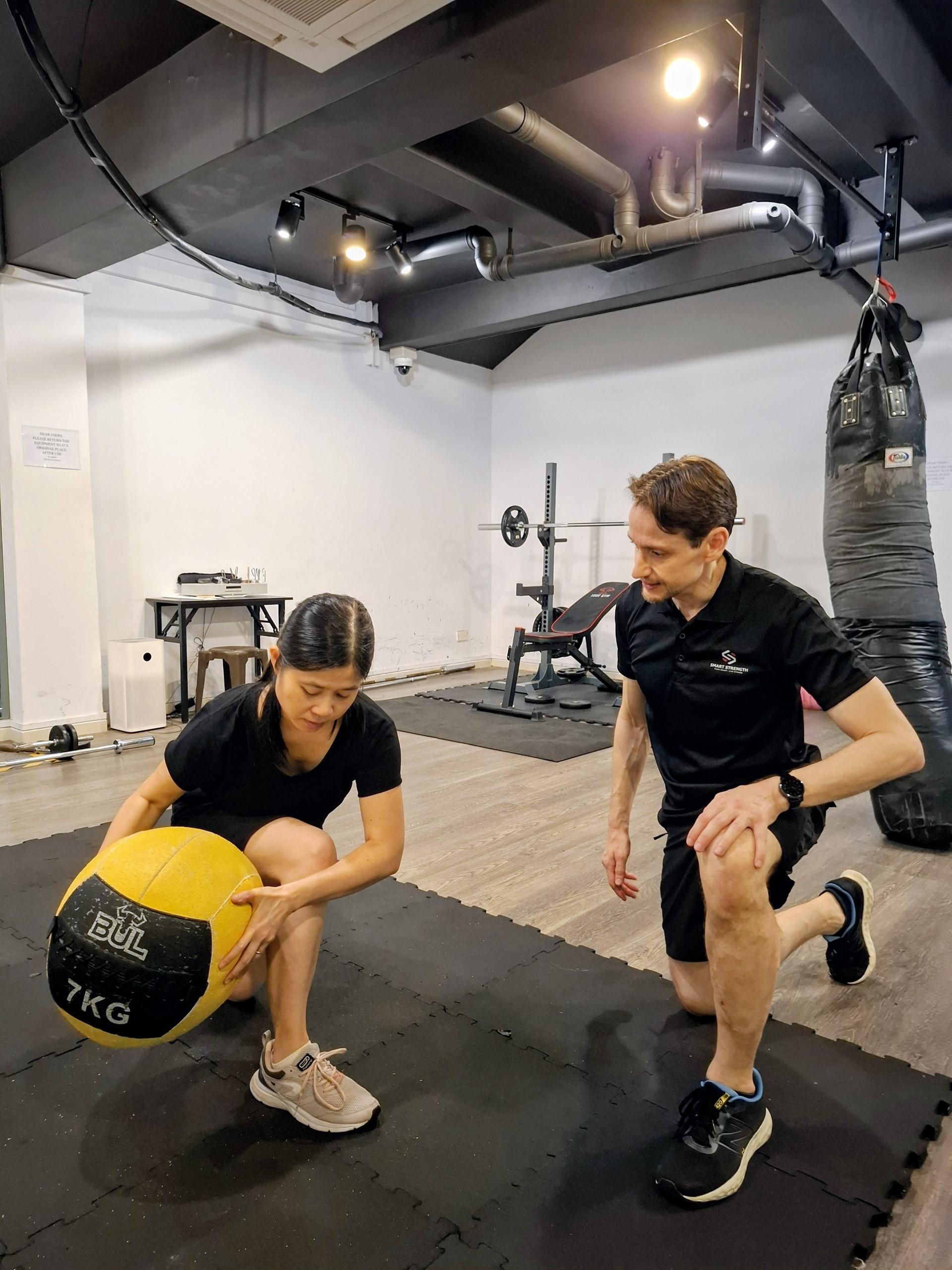
Builds strength and control inside the limits your physio wrote down. AAOS names rotator cuff exercises as part of care, and the physio's programme sets which ones. A coach makes sure they get done, well and often, and adds load slowly.
- 01Rotator cuff strengthBand and light dumbbell external rotation, done as the physio prescribed.
- 02Shoulder blade controlRows, band pull-aparts and wall slides, so the arm has a steady base.
- 03Controlled rangeWorking only through the range the physio has cleared, slowly, with no pushing into a pinch.
- 04Everything elseLegs, trunk and conditioning, which keep your fitness up while the shoulder catches up.
The general pressing ladder and a sample training week are on training with a shoulder injury. This page does not repeat them.
Which lifts should you modify after a labral tear?
The ones that take the arm to the end of its range under load. Ask your physio about each of these by name before you do it, and get the answer in writing.
| Lift | Why we ask your physio first (our coaching view) | How a coach may adjust it, once cleared |
|---|---|---|
| Overhead press | Full overhead range under load. AAOS lists overhead pain as a common symptom | Landmine press or half-kneeling single-arm press first. Barbell overhead last, if your goal needs it |
| Dips | Loads the front of the shoulder at the bottom of the range | Left out until the physio clears it. Push-ups at a set depth instead |
| Bench press depth | The bottom of a wide-grip bench stretches the front of the shoulder | Floor press or a board to limit depth, neutral-grip dumbbells, a narrower grip |
| Pull-ups | Hanging at full stretch overhead, often with a kip or a drop | Rows and lat pulldowns first, then slow pull-ups without a kip or a dead hang drop |
A coach should never push you through instability, sharp pain or numbness. If a lift feels like the shoulder might slip, it stops and the physio hears about it.
How do your coach and physio share the plan?
The physio sets the limits and the coach works inside them. You carry the notes between them, or they talk directly with your permission.
- Physio sets the limitsAsk for them in plain terms: how high the arm can go, which lifts are off, what discomfort is acceptable.
- Coach logs each sessionWhat was done, the loads, and anything that hurt or felt unstable.
- Log goes to the reviewTake that log to each physio review, so the next stage is cleared on real numbers.
- Plan changesIf the physio changes the limits, the plan changes that week.
Bring the physio's sheet to your first session, with the restricted positions and the date of your next review.
Is it different if you are over 50?
AAOS lists wear and tear, including osteoarthritis, among the causes of labral tears, so older lifters see them too. The order stays the same.
- 01DoctorConfirms the tear first.
- 02PhysioRecovery can take longer, so expect your physio to set slower stages.
- 03CoachTrains you inside their limits.
For strength training in general after 50, see strength training after 50.
How does training with a Fit Titans coach work?
Coaches charge from S$50 a session, most S$80 to S$130 (measured 2 October 2026), and your first session is a paid trial at 10% off the coach's rate. After it, training is sold in packs from 5 sessions, paid by PayNow. Coaches come to your home, your condo gym, a park or a gym that allows outside trainers.
Tell us about the tear, the date of any surgery and what your physio has cleared, and send the sheet if you have one. More on how we work around injuries is on injury rehab coaching, and if your back is also a problem, see training with back pain.
Questions about labral tear
How long after labral tear surgery can I lift weights?
Light weights come back with your physio at the strengthening stage, about 3 to 4 months after repair on Tan Tock Seng Hospital's guide, and heavy lifting usually after that. Your surgeon's protocol decides the exact week.
Can I keep training my legs while the shoulder heals?
Usually yes, if your doctor agrees. Leg press, split squats with no load in the injured arm, a stationary bike and trunk work keep your fitness up, while anything that pulls on the arm or needs it to hold a weight waits for the physio's clearance.
What if my shoulder dislocates again?
Go to A&E if it looks out of place or you cannot move the arm, and tell your surgeon. A repeat is not rare: in the Singapore study of 82 shoulders after Bankart repair, 9.8% reported one. Training stops until the surgical team has seen you.
Can a personal trainer rehab my labral tear?
No. Your doctor and physio diagnose and rehabilitate the tear. A coach adds coached strength sessions inside the limits they set, and stops and refers you back if the shoulder feels unstable.
How much does coaching after a labral tear cost?
The same as any 1-to-1 session: coaches charge from S$50, most S$80 to S$130 (measured 2 October 2026), with the first session 10% off. Twice a week through the strengthening stage is about 8 sessions a month, and the physio's own fees are separate.

About this guide
Published
Sources (6)
Sources
- Shoulder joint tear (glenoid labrum tear) (checked 7 Nov 2026) · American Academy of Orthopaedic Surgeons (OrthoInfo)
- Dislocated shoulder (checked 7 Nov 2026) · NHS
- Rehabilitation after shoulder surgery: rotator cuff repairs or SLAP and Bankart repairs (checked 7 Nov 2026) · Tan Tock Seng Hospital, NHG Health
- SLAP repair patient leaflet (checked 7 Nov 2026) · Gateshead Health NHS Foundation Trust
- Shoulder labral tear (checked 7 Nov 2026) · Physio & Sole
- Return to sport and patient satisfaction after arthroscopic Bankart repair (checked 7 Nov 2026) · Singapore Medical Journal
General information, not medical advice.